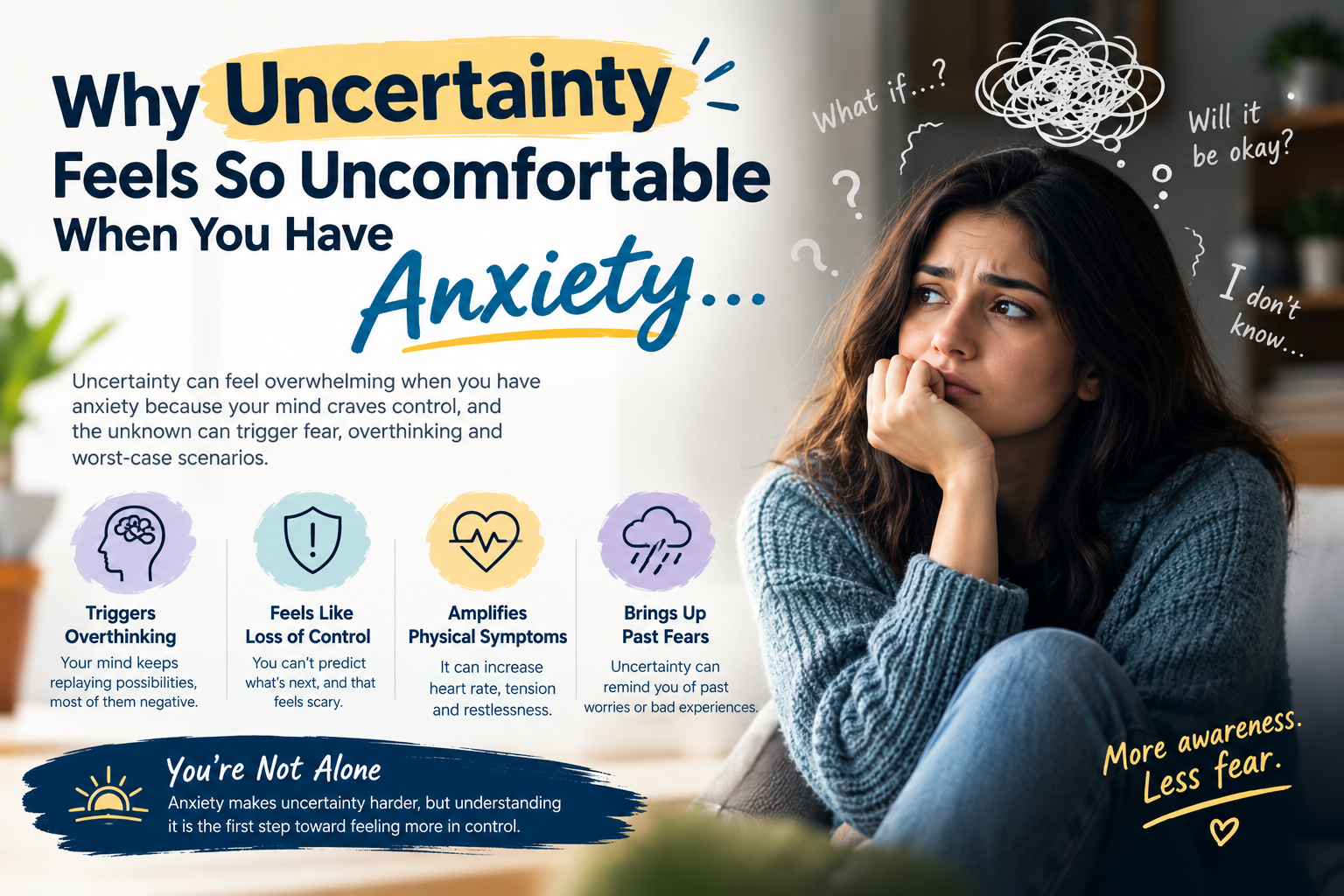
Uncertainty is a normal part of life. You may not know how a conversation will go, whether a decision will work out, what tomorrow will bring, or how someone else will respond. For many people, these unknowns are uncomfortable but manageable.
For someone experiencing anxiety, however, uncertainty can feel much more threatening. Instead of simply thinking, “I don't know what will happen,” the mind may quickly move toward, “What if something goes wrong?” or “What if I make the wrong decision?”
This tendency can create a cycle of worry, reassurance-seeking, overthinking, physical tension, and avoidance.
The American Psychological Association notes that people respond to uncertainty differently and that greater difficulty tolerating uncertainty can be associated with anxiety and negative emotional states.
Understanding why uncertainty feels so uncomfortable when you have anxiety can make the experience easier to recognize and discuss with a healthcare professional.
What Is Uncertainty Anxiety?
Uncertainty anxiety refers to the distress that can occur when you cannot predict or control an outcome.
It does not necessarily mean that something bad is happening. Instead, the discomfort comes from not knowing what might happen.
For example, someone may:
Worry repeatedly about an upcoming conversation
Replay possible outcomes before making a decision
Search for information repeatedly to feel certain
Ask other people for reassurance
Imagine several negative scenarios
Delay decisions because every option feels risky
Feel uncomfortable when plans change unexpectedly
Have difficulty relaxing when something remains unresolved
Occasional worry about uncertain situations is normal. Anxiety becomes more concerning when worry is persistent, difficult to control, or begins interfering with everyday functioning.
The National Institute of Mental Health explains that generalized anxiety disorder involves excessive worry about everyday areas of life, with difficulty controlling the worry and associated symptoms that can affect functioning.
For additional background, the MedlinePlus overview of anxiety disorders explains that anxiety disorders can interfere with daily activities, relationships, school, and work.
Why Does Uncertainty Feel So Threatening?
1. The brain naturally looks for predictability
The human brain constantly interprets information and tries to anticipate what may happen next.
Predictability can create a sense of control. When an outcome is unknown, the brain has less information to work with.
For someone already prone to anxiety, this lack of information may feel like a problem that needs to be solved immediately.
The result can be repeated mental questions:
What if something happens?
What if I missed something?
What if I make the wrong choice?
What if I cannot handle the outcome?
The problem is that many of these questions cannot be answered with certainty.
That can cause the mind to keep searching.
2. Anxiety tends to focus attention on possible threats
Anxiety is closely connected with threat detection. When the future is uncertain, an anxious mind may focus disproportionately on what could go wrong.
For example, imagine waiting for an important email.
A balanced response might be:
“I don't know when they will respond. I'll wait and check later.”
An anxious response might become:
“Why haven't they replied? Did I say something wrong? Are they upset? Did I make a mistake? What happens if I don't get the response?”
The uncertainty has not changed, but the interpretation has.
This is one reason anxiety can make ordinary waiting periods feel emotionally exhausting.
3. Negative possibilities can feel more believable
Anxiety does not necessarily predict the future accurately. Instead, it can make negative possibilities feel especially important.
A person may recognize intellectually that several outcomes are possible but still feel emotionally convinced that the worst outcome deserves the most attention.
This can lead to catastrophic thinking, where the mind repeatedly explores increasingly negative possibilities.
For example:
Uncertainty: “I have an appointment next week.”
Anxious thought: “What if something goes wrong?”
Further worry: “What if the doctor finds something serious?”
Further worry: “What if I can't handle it?”
The chain can continue even though nothing has actually happened.
4. Trying to eliminate uncertainty can increase worry
One of the most frustrating aspects of anxiety is that attempts to achieve complete certainty can sometimes keep the worry going.
A person may repeatedly:
These behaviors may provide temporary relief.
But if the person learns, “I can only feel safe after checking,” the urge to check may return the next time uncertainty appears.
This can create a cycle:
Uncertainty → Anxiety → Checking or reassurance → Temporary relief → More uncertainty → More checking
Learning to tolerate some uncertainty can therefore be an important part of managing anxiety.
How Anxiety and Physical Symptoms Can Connect
Uncertainty does not only affect thoughts.
Anxiety can also produce physical symptoms. The NHS notes that anxiety may involve symptoms such as a noticeable heartbeat, dizziness, headaches, sweating, breathlessness, shaking, and gastrointestinal symptoms.
Muscle tension is another common physical feature associated with anxiety.
If uncertainty repeatedly activates worry, the body may remain tense for long periods.
You can read more about this in our article Why Does Anxiety Make Your Muscles Feel Tight All the Time?.
Persistent tension can also contribute to discomfort in areas such as the neck, shoulders, jaw, and back. Our guide on Why Anxiety Can Cause Muscle Tension and Body Pain explores this mind-body connection in greater detail.
When tension involves the head and neck, some people may also experience headaches. Our article on Why Muscle Tension Can Trigger Headaches discusses how physical tension may relate to headache symptoms.
The Connection Between Uncertainty and Overthinking
Overthinking often develops when the brain attempts to reach a level of certainty that may not be possible.
Consider a simple decision:
“Should I send this message?”
A normal decision may take a few seconds or minutes.
An anxious decision might involve:
Writing the message
Reading it repeatedly
Changing a word
Wondering how it will be interpreted
Asking someone else for an opinion
Rewriting it
Imagining possible responses
Deciding not to send it
Later worrying about not sending it
The person is trying to prevent an unwanted outcome.
But because other people's reactions cannot be completely controlled, the search for certainty may never feel finished.
Why Reassurance Can Become Part of the Cycle
Reassurance is not inherently unhealthy. Talking with someone you trust can be helpful.
The difficulty occurs when reassurance becomes the primary way of managing anxiety.
For example:
“Are you sure everything is okay?”
You receive reassurance.
For a short time, anxiety decreases.
Later, another doubt appears:
“But what if they were wrong?”
The person asks again.
This can create a repeating reassurance cycle.
Instead of developing confidence in handling uncertainty, the person may become increasingly dependent on external confirmation.
That does not mean someone should simply “stop asking for reassurance.” Rather, a mental-health professional can help identify when reassurance has become part of a persistent anxiety pattern.
Uncertainty, Stress, and Procrastination
Uncertainty can also affect productivity.
When a task feels unpredictable, difficult, or emotionally risky, avoiding it can provide immediate relief.
For example:
“I'll start once I know exactly how to do it.”
But many real-world tasks do not come with complete instructions.
The desire for certainty can therefore lead to delays.
Our article Stress and Procrastination: Why Feeling Overwhelmed Can Delay Everything explores how stress and feeling overwhelmed can contribute to procrastination.
The goal is not to eliminate every uncomfortable feeling before taking action. Instead, it can be useful to learn that a person can take reasonable action even while some uncertainty remains.
Can Uncertainty Affect Sleep?
Yes, anxiety-related worry can make it harder to relax at night.
When external distractions become quieter, thoughts that were pushed aside during the day may become more noticeable.
A person might begin thinking about:
The mind may continue trying to solve problems even when there is no immediate action available.
Generalized anxiety disorder can include difficulty sleeping, fatigue, concentration problems, restlessness, and muscle tension.
Poor sleep can then make it harder to regulate stress the following day, potentially creating another cycle:
Uncertainty → Worry → Poor sleep → Fatigue → Greater emotional sensitivity → More worry
How Depression Can Overlap With Anxiety
Anxiety and depression are distinct conditions, but they can occur together.
Someone experiencing persistent uncertainty and worry may also become exhausted, discouraged, withdrawn, or less interested in activities.
Our article When Anxiety and Depression Happen Together: Understanding the Overlap explains how symptoms of anxiety and depression can overlap.
Physical symptoms can also become part of this picture. Read more about The Connection Between Depression, Fatigue, and Muscle Pain for a broader discussion of fatigue and physical discomfort.
Persistent pain and low mood can sometimes reinforce one another as well. Our guide on The Pain Depression Cycle explores this relationship.
How Can You Become More Comfortable With Uncertainty?
The goal is not to become comfortable with every unknown situation immediately.
Instead, the goal can be to gradually develop the ability to experience uncertainty without automatically responding with excessive worry, checking, avoidance, or reassurance-seeking.
1. Identify what you can and cannot control
Ask yourself:
What is within my control right now?
For example, you may control:
Whether you prepare
Whether you communicate clearly
Whether you follow medical advice
Whether you complete an important task
Whether you take a break
Whether you ask for appropriate support
You usually cannot completely control:
The American Psychological Association's guidance on dealing with uncertainty recommends focusing attention on areas within your control while recognizing that uncertainty cannot be completely eliminated.
2. Separate possibility from probability
An anxious mind may say:
“It could happen.”
That statement may technically be true.
But something being possible does not automatically mean it is likely.
Try asking:
“Is this merely possible, or do I have evidence that it is probable?”
This distinction can help reduce the tendency to treat every negative possibility as an immediate threat.
3. Stop trying to solve every hypothetical problem
Some problems can be solved.
Others can only be prepared for.
And some are purely hypothetical.
If your mind keeps generating:
“What if this happens?”
try asking:
“Is there anything useful I can do about this right now?”
If the answer is no, returning attention to the present task may be more productive than continuing the mental simulation.
4. Make decisions using reasonable information
Anxiety can create the expectation that you need 100% certainty before making a decision.
In everyday life, that standard is usually unrealistic.
Instead, consider:
What information do I already have?
What are the realistic options?
What are the potential consequences?
Is additional information genuinely necessary?
Am I researching because I need information or because I want reassurance?
That last question can be particularly useful when anxiety repeatedly drives checking.
5. Practice tolerating small amounts of uncertainty
You do not have to start with your biggest fear.
Instead, practice with small situations.
For example:
Delay checking your phone for a short period
Make a low-risk decision without repeatedly reconsidering it
Allow someone else to choose a minor detail
Send a message without rereading it ten times
Leave a small task imperfect rather than repeatedly editing it
The purpose is to learn:
“I can experience uncertainty without immediately trying to eliminate it.”
6. Pay attention to your body
Anxiety can produce physical symptoms, so calming the body may help you respond more thoughtfully to anxious thoughts.
Helpful strategies may include:
Slow breathing
Regular physical activity
Adequate sleep
Relaxation exercises
Taking breaks from constant information checking
Maintaining regular meals and hydration
Talking with someone you trust
The NHS provides additional guidance for managing anxiety, fear, and panic, including practical approaches and information about when professional support may be appropriate.
What Treatments Can Help With Anxiety?
Treatment depends on the type and severity of anxiety, the person's circumstances, and other health considerations.
For generalized anxiety disorder, treatment may involve psychotherapy, medication, or a combination of both.
Cognitive Behavioral Therapy
Cognitive behavioral therapy, or CBT, is commonly used for generalized anxiety disorder.
CBT can help people identify patterns of thinking and behavior that contribute to anxiety and learn alternative ways of responding.
This may be particularly relevant when uncertainty leads to:
The National Institute of Mental Health identifies CBT as a research-supported psychotherapy commonly used for GAD.
Medication
Medication may also be considered by a healthcare professional depending on the individual's diagnosis and circumstances.
NIMH notes that medications used for GAD can include antidepressants such as SSRIs and SNRIs, as well as certain anti-anxiety medications.
Medication should be discussed with a qualified healthcare professional rather than selected or changed based solely on online information.
For a broader overview of approaches to anxiety treatment, see our article Why Some Anxiety Treatments Target the Brain While Others Target the Body.
When Should You Seek Professional Help?
Occasional uncertainty and worry are normal.
Consider speaking with a healthcare professional if anxiety:
Feels difficult to control
Is present most days
Interferes with work or school
Disrupts relationships
Causes persistent sleep problems
Leads to significant avoidance
Makes everyday decisions extremely difficult
Causes substantial physical symptoms
Is becoming increasingly difficult to manage
The NHS recommends seeking medical support when anxiety, fear, or panic is difficult to cope with or self-help approaches are not helping.
The NHS guidance on generalized anxiety disorder also explains that persistent anxiety affecting everyday life may warrant professional assessment.
Importantly, anxiety symptoms can overlap with other physical or mental-health conditions. Avoid assuming that every physical symptom is caused by anxiety without appropriate medical evaluation.
Frequently Asked Questions
Why does uncertainty trigger anxiety?
Uncertainty removes predictability and can make it harder to feel in control. An anxious mind may respond by focusing heavily on possible negative outcomes and attempting to obtain reassurance or certainty.
Is intolerance of uncertainty a symptom of anxiety?
Difficulty tolerating uncertainty is associated with anxiety, but it is not by itself enough to diagnose an anxiety disorder. A healthcare professional considers the broader pattern of symptoms, duration, severity, and impact on daily life.
Why do I overthink things I cannot control?
Overthinking can be an attempt to prevent negative outcomes. When the situation cannot actually be controlled or predicted, repeated mental analysis may continue without producing a useful solution.
Can anxiety cause physical symptoms?
Yes. Anxiety can be associated with physical symptoms including muscle tension, headaches, sweating, shaking, digestive symptoms, dizziness, and changes in heart rate.
Can CBT help with fear of uncertainty?
CBT is commonly used for generalized anxiety disorder and can help people recognize unhelpful thought and behavior patterns. A qualified mental-health professional can determine whether CBT is appropriate for an individual's situation.
Should I try to eliminate uncertainty completely?
Complete certainty is usually impossible. A more practical goal is learning to tolerate reasonable amounts of uncertainty while focusing on actions that are actually within your control.
Final Thoughts
Why uncertainty feels so uncomfortable when you have anxiety is not simply a question of being pessimistic or worrying too much.
For some people, uncertainty activates a strong desire for prediction, control, reassurance, or safety. The mind may repeatedly analyze possible outcomes in an attempt to prevent something from going wrong.
But uncertainty cannot always be eliminated.
A healthier long-term approach may involve learning to distinguish realistic preparation from excessive worry, focusing on what can actually be controlled, reducing repetitive reassurance-seeking, and gradually becoming more comfortable with situations that do not have guaranteed outcomes.
If anxiety is persistent or interfering with daily life, professional assessment can help identify what is happening and what treatment options may be appropriate.