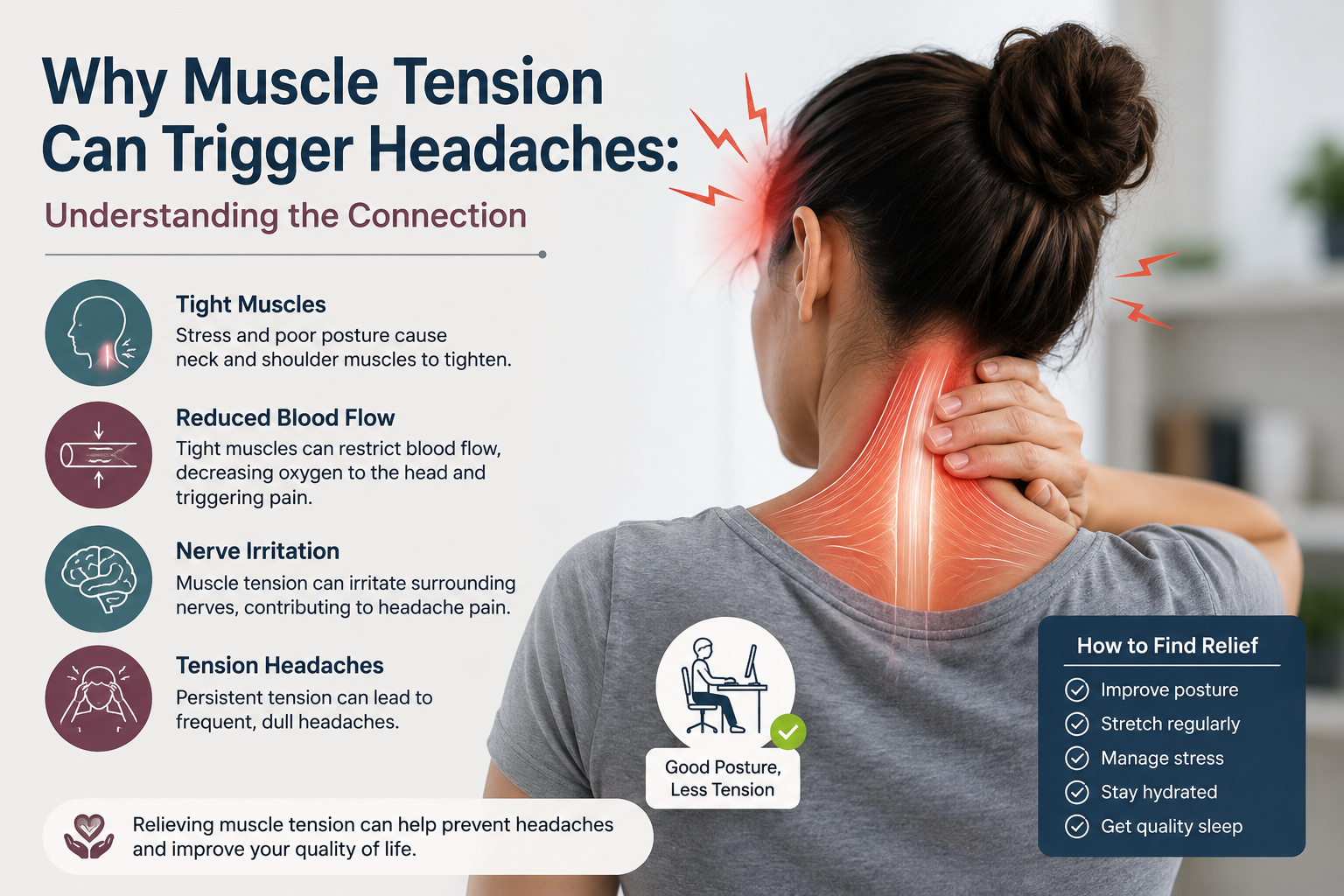
A headache can sometimes seem to appear out of nowhere. You may wake up with pressure around your forehead, notice aching near your temples after a long workday, or feel a dull pain spreading from your neck toward the back of your head.
One possible contributor is muscle tension.
Tight muscles around the neck, shoulders, scalp, jaw, and upper back can accompany or contribute to certain types of headaches, particularly tension-type headaches. These headaches are among the most common types of headache and are often described as pressure, tightness, or a band-like sensation around the head. Mayo Clinic — Tension Headaches
But why does a tight muscle in your neck or shoulders sometimes seem to end up as pain in your head?
Let's take a closer look.
What Is Muscle Tension?
Muscle tension occurs when muscles remain contracted or tightened instead of fully relaxing.
This can happen temporarily after physical activity, prolonged sitting, an awkward sleeping position, repetitive movements, or emotional stress.
You might notice:
Sometimes the tension is obvious. Other times, you may not realize you're holding your muscles tightly until discomfort develops.
How Can Muscle Tension Contribute to Headaches?
The neck, shoulders, scalp, jaw, and head are connected through muscles, nerves, and pain-processing pathways.
When muscles remain tense for extended periods, they can become uncomfortable or tender. Sensory signals from these areas can contribute to pain experienced around the head.
Tension-type headaches commonly involve pain or pressure affecting both sides of the head and may involve the forehead, temples, or back of the head and neck. Cleveland Clinic — Tension Headaches
This is why someone may describe the experience as:
"My shoulders are tight, and then I start getting a headache."
The relationship isn't always as simple as one tight muscle directly "causing" the headache. Headaches can have multiple contributing factors, including stress, sleep problems, posture, physical strain, and individual sensitivity to pain.
Stress Can Make the Cycle Stronger
One of the most interesting connections is between stress and muscle tension.
When you're stressed, your body can automatically increase muscle activity. You may unconsciously raise your shoulders, tighten your jaw, clench your teeth, or stiffen your neck.
You might not even notice you're doing it.
Over time, this can contribute to discomfort.
The pattern may look like:
Stress → muscle tightening → neck/shoulder discomfort → headache → more stress → additional tension
This doesn't mean every stress-related headache is caused by muscle tension. But reducing sources of tension can be one useful part of managing recurrent headaches.
The National Institute of Neurological Disorders and Stroke notes that tension-type headaches can be associated with stress and muscle tension. NINDS — Headache Information
Your Neck May Be Part of the Problem
Think about how you sit when you're concentrating.
Your head may move forward toward the screen.
Your shoulders may rise slightly.
Your upper back may become rounded.
Your neck muscles then have to work continuously to support your head.
Doing this for several hours doesn't necessarily mean you've "damaged" your neck. However, prolonged static positions can contribute to muscle fatigue and discomfort.
This is especially relevant for people who spend much of their day:
Taking regular movement breaks and changing positions can help reduce prolonged muscle loading.
The "Tech Neck" Connection
Smartphone and computer use have introduced another common source of neck and shoulder discomfort.
When your head stays tilted downward for long periods, the muscles around your neck and upper back have to maintain that position.
Over time, you may notice:
Neck stiffness → shoulder tightness → upper-back discomfort → headache
However, it's important not to assume that every headache associated with screen use is caused by posture.
Eye strain, inadequate breaks, poor lighting, dehydration, sleep deprivation, and other factors can also contribute to headaches.
Jaw Tension Can Also Matter
Your jaw and head aren't isolated from one another.
Some people clench their teeth or tighten their jaw when they're stressed, concentrating, or sleeping.
Jaw muscle tension can produce pain around the temples, face, and head.
If you regularly wake up with:
Jaw soreness
Facial tenderness
Tooth sensitivity
Temple pain
Headaches
it may be worth discussing the symptoms with a dentist or healthcare professional.
Why Does the Pain Feel Like Pressure?
Tension-type headaches are often described differently from migraine.
Instead of severe throbbing pain, people commonly describe tension headaches as:
Pressure
Tightness
A squeezing sensation
A band around the head
Dull or aching pain
The discomfort may occur on both sides of the head.
According to Mayo Clinic, tension headaches may involve tenderness in the scalp, neck, and shoulder muscles. Mayo Clinic — Tension Headache Symptoms and Causes
Muscle Tension vs. Migraine
Not every headache associated with neck discomfort is a tension headache.
Migraines can also involve neck pain or stiffness, and their symptoms can be considerably different.
Migraine may involve:
Tension-type headaches generally don't have the same combination of symptoms.
Because different headache disorders can overlap, repeatedly self-diagnosing every headache as a "tension headache" isn't always appropriate.
Can Poor Sleep Increase Muscle Tension?
Yes, poor sleep can contribute to a difficult cycle.
When you're sleep-deprived, you may become more sensitive to discomfort and less able to cope with everyday stress.
Poor sleep can also affect your posture, energy levels, concentration, and physical activity.
If you're waking up with headaches frequently, consider looking at your sleep quality, not just the pillow.
Ask yourself:
Am I getting enough sleep?
Do I wake frequently?
Am I clenching my jaw?
Is my neck comfortable?
Do I wake feeling rested?
Are headaches occurring mostly in the morning?
Persistent morning headaches deserve discussion with a healthcare professional, particularly if they are new or accompanied by other symptoms.
What Can Help Relax Tense Muscles?
For occasional muscle tension, simple measures may help.
Take Movement Breaks
If you work at a desk, avoid remaining in exactly the same position for hours.
Stand up.
Walk around.
Change your sitting position.
Gently move your neck and shoulders.
Use Gentle Stretching
Gentle stretching may help some people reduce stiffness.
Avoid forcing a stretch or pushing into sharp pain.
Try Heat
A warm shower or heating pad may help relax tight muscles for some people.
Use heat safely and avoid excessive temperatures.
Pay Attention to Your Jaw
During the day, check whether you're clenching your teeth.
If you notice tension, consciously relax your jaw rather than holding it tightly.
Improve Your Workspace
Your computer screen, chair, keyboard, and desk arrangement can influence how you hold your neck and shoulders.
The goal isn't to maintain one "perfect" posture all day.
Movement variety is often more useful than trying to hold yourself rigidly in one position.
Manage Stress
Stress management can be useful when tension headaches are associated with emotional stress.
Activities such as walking, breathing exercises, relaxation techniques, mindfulness, and regular physical activity may help some people.
What About Pain Medication?
Over-the-counter pain relievers can help some people with occasional tension-type headaches.
However, frequently using headache medication can itself contribute to medication-overuse headaches.
If you're regularly needing medication for headaches, it's better to discuss the pattern with a healthcare professional rather than repeatedly treating each headache on your own. The American Migraine Foundation provides information about medication-overuse headache and headache treatment. American Migraine Foundation — Medication Overuse Headache
When Should You See a Doctor?
Occasional tension headaches are common, but recurring headaches deserve attention when they begin interfering with everyday life.
Consider talking with a healthcare professional if:
Headaches are becoming more frequent
Headaches are becoming more severe
Your usual headache pattern changes
You're regularly relying on pain medication
Headaches interfere with work or sleep
You frequently experience neck pain alongside headaches
You have unexplained or persistent neurological symptoms
Keeping a headache diary can also be useful.
Record when the headache occurs, how long it lasts, what it feels like, your sleep, food and fluid intake, stress level, physical activity, and any medications you took.
Patterns can sometimes become easier to identify when they're written down.
???? When Is a Headache an Emergency?
Some headaches require urgent medical evaluation.
Seek emergency medical care for a sudden, extremely severe headache, especially if it reaches maximum intensity very quickly.
Urgent evaluation is also important if a headache occurs with symptoms such as:
A sudden severe headache can sometimes signal a serious medical condition and shouldn't simply be assumed to be muscle tension. NHS — Headaches
Final Thoughts
Muscle tension and headaches can be closely connected, particularly when stress, prolonged positioning, physical strain, or jaw tension are involved.
But a headache isn't simply a signal that "your muscles are tight."
Headaches have many possible causes, and understanding the overall pattern is more useful than focusing on one symptom.
If you regularly experience tight shoulders, neck stiffness, jaw tension, and pressure-like headaches, paying attention to your daily habits may reveal useful clues.
Sometimes the first step isn't asking, "How do I get rid of this headache?"
It may be asking:
"What is happening in my body before the headache begins?"
That shift in perspective can help you identify triggers, make appropriate lifestyle changes, and know when it's time to seek professional advice.