Anxiety can begin with a thought, but it rarely stays in the mind.
A stressful thought can trigger a racing heartbeat. A feeling of uncertainty can make your shoulders tighten. Fear can change your breathing, disturb your stomach, interrupt sleep, and leave you physically exhausted.
This is why anxiety treatment isn't always focused on just one part of the experience.
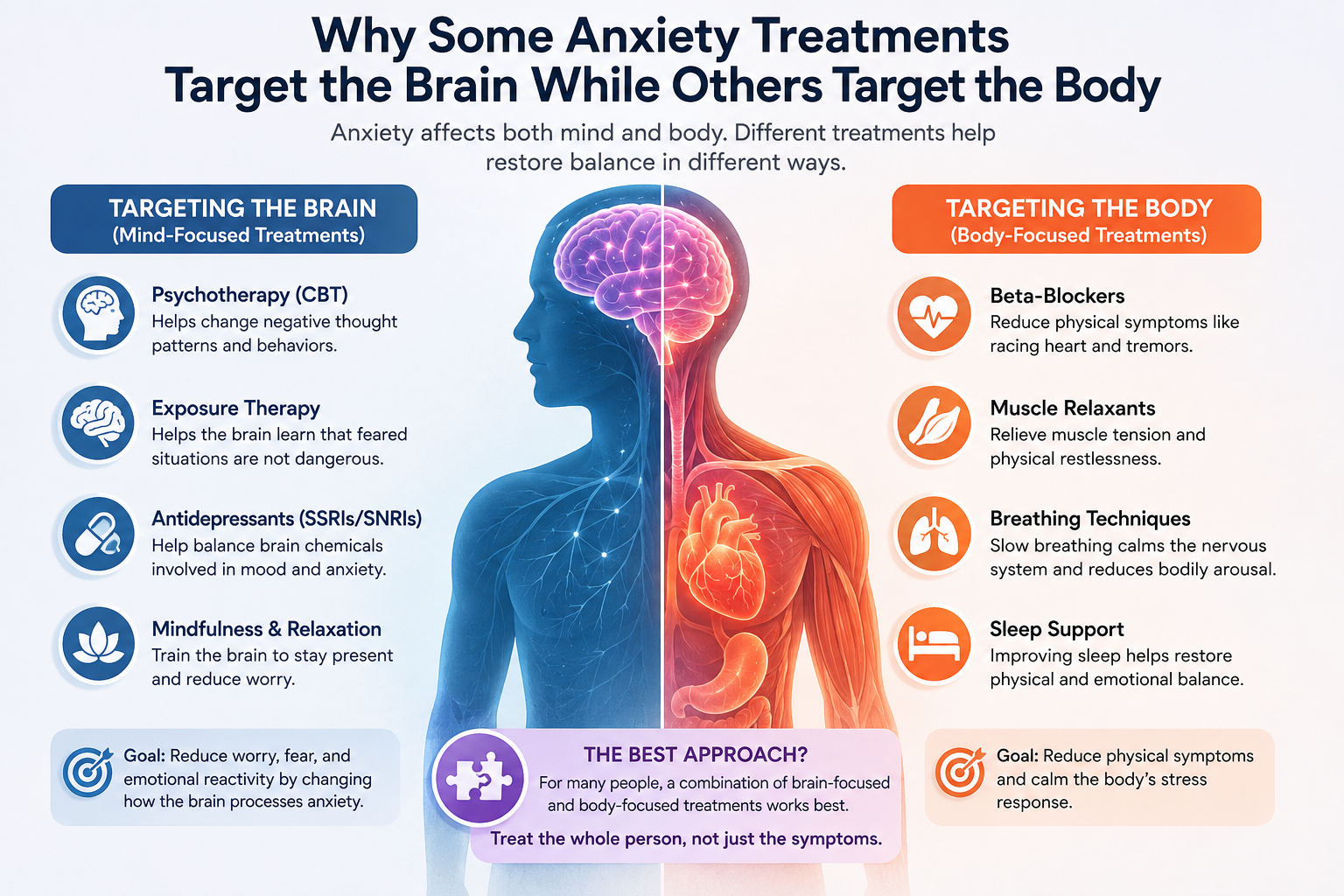
Some treatments primarily address the thoughts, emotions, and brain processes associated with anxiety, while others are designed to reduce particular physical symptoms such as rapid heartbeat, muscle tension, or severe agitation.
Understanding this difference can make anxiety treatment seem much less confusing.
Medical disclaimer: This article is for educational purposes and isn't a diagnosis or personalized medical advice. Prescription medications should only be used under the supervision of an appropriately qualified healthcare professional.
Anxiety Is Both a Mental and Physical Experience
Anxiety is often described as excessive worry or fear, but the experience can involve the entire body.
When the brain perceives a possible threat, the body's stress-response systems can become activated. This may produce symptoms such as:
The National Institute of Mental Health (NIMH) explains that generalized anxiety disorder can involve excessive, difficult-to-control worry as well as physical symptoms such as restlessness, fatigue, muscle tension, and sleep problems.
This mind-body relationship explains why two people with anxiety may require different treatment approaches.
One person may primarily struggle with persistent worrying and intrusive thoughts. Another may experience intense physical symptoms such as shaking, sweating, or a pounding heart.
Treatment needs to consider the whole picture.
What Does It Mean to “Target the Brain”?
When people say that an anxiety treatment targets the brain, they generally mean that the treatment is intended to influence the processes involved in anxiety, including patterns of thinking, emotional responses, and brain signaling.
This doesn't mean that the brain is being “fixed” in a simplistic sense.
Rather, treatment may help change the way a person responds to anxious thoughts, situations, and sensations.
Psychotherapy targets thought and behavior patterns
One of the best-known psychological treatments for anxiety is cognitive behavioral therapy (CBT).
CBT helps people identify automatic patterns of thinking and examine how thoughts influence emotions and behavior. It can also help people gradually change behaviors that maintain anxiety.
NIMH describes CBT as a well-studied treatment for generalized anxiety disorder and other anxiety disorders.
For example, imagine someone experiences a fast heartbeat before speaking publicly.
Their first thought might be:
“Everyone will notice that I'm nervous.”
That thought can increase fear, which can increase physical symptoms, which then seems to confirm the original thought.
CBT can help break down this cycle.
Instead of automatically treating the physical sensation as evidence of danger, the person learns to recognize the thought, question it, and develop a more balanced response.
Exposure Can Change the Fear Response
Some anxiety disorders involve avoiding situations that trigger fear.
Avoidance can provide short-term relief, but it may also reinforce the belief that the situation is dangerous.
Exposure-based approaches, which are often used within CBT, involve gradually confronting feared situations in a structured and appropriate way.
NIMH notes that exposure therapy can be used for social anxiety and other anxiety conditions to help people progressively confront fears and reduce avoidance.
The goal isn't to overwhelm someone.
It's to help the brain learn:
“I can experience this situation without automatically escaping from it.”
Over time, this can change the relationship between the person and the feared situation.
What About Anxiety Medication?
Medication is another treatment approach that can influence the brain's signaling systems.
For anxiety disorders, healthcare professionals may consider several medication classes depending on the specific condition.
These can include:
NIMH explains that SSRIs and SNRIs are commonly used for anxiety disorders and may take several weeks to begin working.
This is important because medication that doesn't produce an immediate dramatic effect isn't necessarily ineffective.
Some treatments are intended for longer-term symptom management rather than immediate relief.
Why Do Some Anxiety Treatments Take Weeks?
A common question is:
“If I'm anxious today, why doesn't my medication work immediately?”
Different medications work differently.
SSRIs and SNRIs, for example, generally aren't considered instant-relief medications. Their effects develop over time.
NIMH notes that these medications may take several weeks to start working.
This is one reason treatment should be monitored by a healthcare professional rather than adjusted independently.
A clinician can evaluate whether symptoms are improving, whether side effects are tolerable, and whether another treatment approach should be considered.
What Does It Mean to Target the Body?
Some interventions focus more directly on physical manifestations of anxiety.
Consider performance anxiety.
A person may know intellectually that giving a presentation isn't dangerous, yet their body may respond with:
Trembling hands
Sweating
Rapid heartbeat
Shaky voice
In certain circumstances, healthcare professionals may use medications such as beta-blockers to reduce some physical symptoms.
NIMH explains that beta-blockers may be used off-label for certain short-term anxiety symptoms, particularly physical symptoms such as rapid heartbeat, sweating, and tremors.
However, these medications don't necessarily eliminate the underlying anxious thoughts.
That's an important distinction.
Reducing a racing heartbeat is not necessarily the same as changing the fear that caused the anxiety.
Why Physical Symptoms Can Become a Feedback Loop
The relationship between the brain and body works in both directions.
Imagine this sequence:
Anxious thought → adrenaline response → faster heartbeat → noticing heartbeat → “Something is wrong” → increased anxiety → stronger physical response.
This is one reason panic attacks can feel so frightening.
The physical sensation itself can become a new source of fear.
NIMH notes that panic disorder can involve sudden episodes of intense fear accompanied by physical symptoms, and treatment can include psychotherapy and medication.
Learning to understand these sensations can therefore be an important part of treatment.
What About Muscle Relaxation?
Anxiety frequently produces physical tension.
You may not consciously decide to tighten your shoulders, jaw, or neck, but prolonged stress can leave muscles feeling uncomfortable.
Relaxation-based approaches can specifically address this physical component.
NICE includes applied relaxation as one psychological treatment option for generalized anxiety disorder. It involves learning relaxation techniques and applying them when anxiety arises.
This demonstrates that “body-focused” treatment doesn't necessarily mean medication.
A behavioral technique can also target physical symptoms.
Why Treatment Often Works Best as a Combination
Anxiety isn't always one problem.
Someone may simultaneously experience:
Worry + muscle tension + insomnia + avoidance + panic symptoms.
Treating only one component may leave other parts of the cycle intact.
For some people, psychotherapy may be enough. Others may benefit from medication. Some may need a combination.
NICE recommends considering psychological treatment and medication according to symptom severity, treatment response, preferences, and individual circumstances.
The right approach therefore isn't necessarily:
Brain treatment OR body treatment.
It can be:
Brain + body + behavior + lifestyle.
Why Benzodiazepines Are Different
Benzodiazepines are a particularly important example because they can produce relatively rapid reductions in severe anxiety symptoms.
However, they aren't appropriate for everyone or for indefinite use.
NIMH notes that benzodiazepines can rapidly decrease anxiety but that tolerance and dependence can develop in some people, which is why healthcare providers may prescribe them for shorter periods.
NICE similarly recommends that benzodiazepines generally not be used for generalized anxiety disorder except as a short-term measure during crises.
This is why medication decisions shouldn't be based simply on which medicine “works fastest.”
The more important questions are:
What is the diagnosis?
What is the treatment goal?
What are the benefits and risks?
How long is the treatment intended to continue?
Why the Same Medication Isn't Right for Everyone
Anxiety isn't a single condition.
Generalized anxiety disorder, panic disorder, social anxiety disorder, phobias, and anxiety associated with other mental or physical conditions can require different approaches.
A person's:
Age
Medical history
Other medications
Symptoms
Previous treatment response
Substance use
Pregnancy status when applicable
Other mental-health conditions
can influence treatment decisions.
NICE recommends comprehensive assessment that considers coexisting depression, other anxiety disorders, substance use, medical conditions, and previous treatment experiences.
So an online list of “best anxiety medications” can't replace an individualized clinical assessment.
Can Lifestyle Changes Target the Body Too?
Absolutely.
Lifestyle changes aren't a replacement for appropriate treatment when someone has a significant anxiety disorder, but they can support overall mental and physical health.
Useful habits can include:
Regular physical activity
Exercise can support general physical and mental well-being and may be incorporated into an overall anxiety-management plan.
Consistent sleep
Poor sleep can make emotional regulation more difficult and can intensify the experience of stress.
Reducing excessive caffeine
Caffeine can produce physical sensations such as increased alertness and a faster heartbeat, which some people may interpret as anxiety.
Relaxation practices
Breathing exercises, mindfulness, progressive muscle relaxation, and other relaxation strategies may help people manage physical arousal.
Social connection
Talking with trusted people can provide emotional support and reduce isolation.
NIMH includes healthy habits such as adequate sleep, exercise, healthy eating, and social support among approaches that can support mental health and panic-disorder management.
The Most Important Point: Treat the Person, Not Just the Symptom
Imagine two people with racing heartbeats.
One may be experiencing an anxiety disorder.
Another may have a medical condition, medication effect, stimulant exposure, or another cause.
That's why repeatedly treating a physical symptom without understanding its cause can be problematic.
Similarly, assuming every physical sensation is “just anxiety” can sometimes cause a genuine medical problem to be overlooked.
Persistent, severe, new, or unexplained physical symptoms deserve appropriate medical evaluation.
What Should You Ask Your Doctor?
If you're discussing anxiety treatment with a healthcare professional, consider asking:
What type of anxiety am I experiencing?
Which symptoms are we trying to treat?
Would psychotherapy be appropriate?
Would medication be useful?
How long should the medication take to work?
What side effects should I watch for?
How will we measure whether treatment is working?
Are there interactions with my other medications?
What happens if the first treatment doesn't work?
How should medication changes or discontinuation be handled?
These questions can turn treatment into a collaborative process rather than simply receiving a prescription.
Final Thoughts
Anxiety is neither purely a problem of the mind nor purely a problem of the body.
It is a mind-body experience.
That is why some treatments focus on thoughts and behaviors, while others address physical symptoms or brain signaling.
CBT can help change patterns of thinking and avoidance. Exposure approaches can help reduce fear-based avoidance. Relaxation can address physical tension. Certain medications can influence brain signaling, while medications such as beta-blockers may sometimes be used to reduce particular physical symptoms.
The goal isn't necessarily to eliminate every anxious sensation.
The goal is to reduce the cycle in which thoughts trigger physical symptoms, physical symptoms trigger more fear, and fear reinforces the original thoughts.
For some people, one treatment approach is enough. For others, a combination of psychotherapy, medication, healthy routines, and professional monitoring provides a more comprehensive strategy.
Most importantly, anxiety treatment should be individualized, evidence-based, and medically supervised rather than based on the idea that one medication or technique works for everyone.