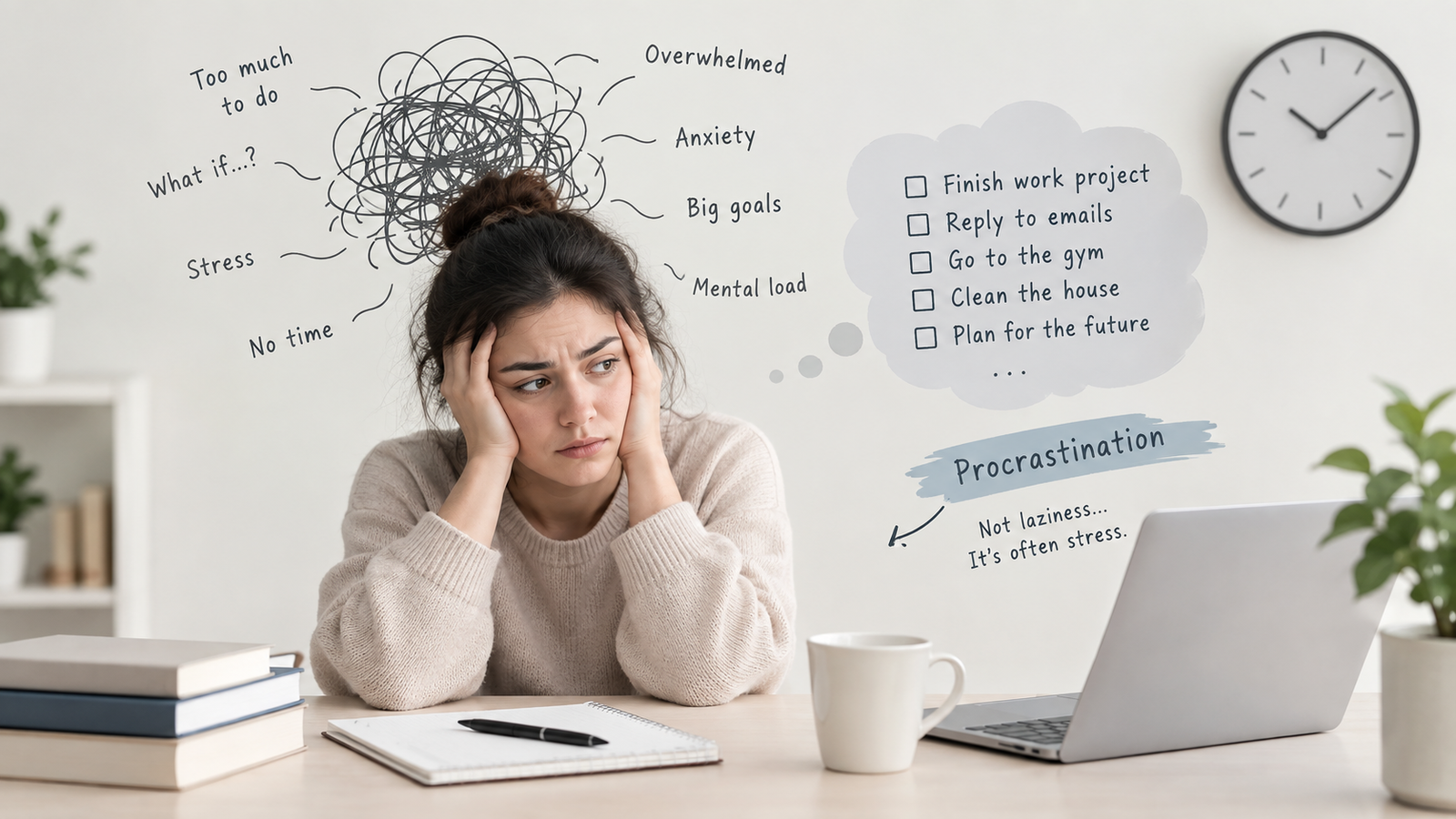
Stress and Procrastination: Why Feeling Overwhelmed Can Delay Everything
Have you ever had an important task in front of you but found yourself doing almost anything else instead? You may check your phone, reorganize your workspace, watch a video, answer unnecessary emails, or simply tell yourself that you will start later.
Then the deadline gets closer, the pressure increases, and the task feels even harder to begin.
This pattern can be more than ordinary poor time management. Stress and procrastination can reinforce each other, particularly when a task feels overwhelming, uncertain, unpleasant, or emotionally demanding. Psychological research discussed by the American Psychological Association suggests that procrastination can function as a short-term way of managing uncomfortable emotions rather than simply reflecting laziness or poor planning.
Understanding procrastination from stress can therefore change how you approach the problem. Instead of asking, “Why am I so lazy?” it may be more useful to ask, “What about this task feels difficult to face right now?”
For a broader look at how stress and anxiety can affect the body, readers can also explore anxiety and muscle tension.
What Is the Connection Between Stress and Procrastination?
Stress is the physical or mental response to an external challenge or demand. It can occur because of work, school, finances, relationships, health concerns, deadlines, or major life changes. Short-term stress can sometimes motivate action, but prolonged or overwhelming stress can interfere with daily functioning.
Procrastination, meanwhile, involves unnecessarily delaying a task even when you understand that postponing it may create problems later.
The two can form a cycle:
Stress → uncomfortable emotions → task avoidance → temporary relief → approaching deadline → more stress → further procrastination
Imagine that you have a large work assignment. You already feel tired and worried that you will not complete it correctly. Opening the document reminds you of that pressure, so you decide to take a short break.
The break feels good.
But the task remains unfinished.
Later, the deadline is closer, and your stress is higher than before.
This is one reason stress-related procrastination can become self-reinforcing.
Stress can also appear through physical symptoms. For example, persistent tension, headaches, tiredness, sleep problems, and difficulty focusing may accompany prolonged stress.
Why Feeling Overwhelmed Makes Starting Difficult
A major reason people procrastinate under stress is that the task no longer feels like one simple activity.
Instead, your mind may see dozens of separate problems at once:
Where should I start?
What if I make a mistake?
How long will this take?
What if I cannot finish?
What if the result isn't good enough?
What should I do first?
What if something else becomes urgent?
When several concerns appear simultaneously, even a relatively manageable task can feel enormous.
The result is overwhelm.
The American Psychological Association notes that procrastination can be connected to negative emotions and emotion regulation. Avoiding an unpleasant task can provide immediate emotional relief, even though it creates additional problems later.
That immediate relief is important.
You are not necessarily avoiding the task because you do not care about it. Sometimes you are avoiding the uncomfortable feelings associated with doing it.
For people whose stress is also accompanied by physical tension, Prescription24x7's article on how anxiety can cause persistent muscle tightness provides a related mind-body perspective.
Procrastination Can Provide Temporary Emotional Relief
One of the most interesting aspects of stress and procrastination is that procrastination can feel helpful in the short term.
When you postpone something stressful, the immediate pressure may decrease.
For example:
Task: Finish an important report.
Thought: “I have no idea how I'm going to finish this.”
Action: Put it off.
Immediate result: “At least I don't have to deal with it right now.”
That temporary relief can reinforce the behavior.
Unfortunately, the original responsibility has not disappeared.
The deadline continues approaching, and the unfinished task may remain in the back of your mind.
Eventually, you may experience:
Increased worry
Guilt
Frustration
Reduced concentration
More pressure
Poorer sleep
Lower confidence
Even greater avoidance
Research on procrastination and stress suggests that repeatedly using delay to escape uncomfortable feelings can become a pattern that contributes to additional distress.
The Stress–Procrastination–Stress Cycle
The relationship can become a repeating loop.
1. A stressful task appears
You receive a difficult assignment, important email, financial responsibility, work project, or personal obligation.
2. Your brain anticipates discomfort
You may expect boredom, uncertainty, failure, criticism, or frustration.
3. You delay the task
You choose another activity that feels easier or more pleasant.
4. You experience temporary relief
For a short time, you no longer have to face the uncomfortable task.
5. The deadline approaches
The amount of time available becomes smaller.
6. Stress increases
The task now feels even more urgent.
7. Starting becomes harder
The increased stress makes avoidance more tempting.
This is why simply telling yourself to “work harder” may not always solve the problem.
Sometimes the underlying issue is the emotional response to the task.
The same pattern can occur with health-related responsibilities. For example, someone experiencing persistent physical discomfort may delay seeking help because thinking about the problem creates additional worry. If muscle discomfort is part of the picture, readers can review Muscle Spasm vs. Muscle Pain for general educational information.
How Stress Can Affect Productivity
The relationship between productivity and stress is complicated.
A certain amount of pressure can encourage action. A deadline may help you focus and prioritize. MedlinePlus explains that short-term stress can sometimes help a person respond to challenges or meet a deadline.
However, excessive or persistent stress can make concentration, decision-making, and task completion more difficult.
NIMH notes that stress can become concerning when symptoms interfere with everyday life, cause avoidance, or seem to be constantly present.
Stress can also produce physical and emotional symptoms such as tiredness, headaches, sleep problems, forgetfulness, and difficulty focusing.
That means someone may appear to be procrastinating when they are actually struggling with mental overload.
For additional health education, readers can browse the Prescription24x7 Health Blog for related articles and medication-health guides.
Stress Can Make Simple Tasks Feel Complicated
When your stress level is high, even routine responsibilities may feel unusually demanding.
For example, replying to one email may normally take five minutes.
But when you are already overwhelmed, you might think:
“I need to answer this correctly.”
“What if they ask another question?”
“I have three other emails.”
“I should finish the bigger project first.”
Suddenly, a five-minute task becomes another source of mental pressure.
You postpone it.
Then the unanswered email becomes another unfinished responsibility.
This is how small delays can accumulate into a much larger feeling of being overwhelmed.
Long-term stress can also affect sleep, concentration, mood, and physical well-being. MedlinePlus recommends recognizing stressors and using healthy strategies such as exercise, relaxation, adequate sleep, social connection, and realistic priorities.
Perfectionism Can Make Stress-Related Procrastination Worse
Not all procrastination comes from having too much to do.
Sometimes it comes from wanting to do something perfectly.
If you believe that your work must be excellent before you begin, starting can feel risky.
You may think:
“I need to know exactly what I'm doing first.”
“I'll start when I have more energy.”
“I need the perfect plan.”
“I don't want to submit anything unless it's excellent.”
This can create a dangerous pattern:
High expectations → fear of doing it incorrectly → avoidance → deadline pressure → rushed work
Reducing the expectation that everything must be perfect can sometimes make it easier to begin.
The goal is not necessarily to produce your best possible work immediately.
The goal is to create movement.
How to Break the Stress and Procrastination Cycle
The solution does not have to involve completely reorganizing your life.
Small changes can make a task feel more manageable.
1. Make the First Step Extremely Small
Instead of saying:
“I need to finish the entire report.”
Try:
“I will open the document and write the heading.”
Or:
“I will work on it for ten minutes.”
A large task creates psychological resistance.
A small first step creates an entry point.
Once you begin, continuing may feel easier.
2. Break Large Tasks Into Smaller Actions
If a project contains ten different responsibilities, write them separately.
For example:
Instead of:
“Complete project.”
Try:
Gather information.
Create an outline.
Write the introduction.
Complete the first section.
Review the draft.
Make corrections.
Submit the final version.
Breaking down overwhelm can reduce the feeling that everything must be handled simultaneously.
MedlinePlus similarly recommends identifying what needs attention and recognizing which responsibilities can wait rather than treating every task as equally urgent.
3. Identify What You Are Actually Avoiding
Ask yourself:
“What feeling am I trying to avoid?”
It might be:
Fear of failure
Boredom
Confusion
Frustration
Embarrassment
Uncertainty
Perfectionism
Fear of criticism
This question can be surprisingly useful because the problem may not be the task itself.
You may be avoiding the emotional experience connected to the task.
4. Use a Short, Defined Work Period
Instead of committing to hours of work, choose a limited period.
For example:
“I will work on this for 15 minutes.”
When the period ends, you can reassess.
This approach can make an intimidating task feel less permanent.
5. Reduce Distractions Before Starting
If your phone, social media, television, or unnecessary notifications are constantly available, switching away from an uncomfortable task becomes easy.
Try creating a temporary distraction-free environment.
Put the phone away.
Close unnecessary browser tabs.
Turn off nonessential notifications.
Keep only the materials required for the task in front of you.
6. Prioritize Rather Than Trying to Do Everything
Stress often increases when every responsibility feels equally urgent.
NIMH recommends recognizing stress triggers and using practical coping strategies when feeling overwhelmed.
You can divide responsibilities into:
Do now
Do later
Delegate if possible
Remove if unnecessary
This can reduce mental clutter.
7. Take Real Breaks
A break should actually allow you to recover.
Instead of switching from one stressful activity to another, consider taking a short walk, stretching, practicing slow breathing, or stepping outside.
Healthy stress-management strategies include physical activity, adequate sleep, relaxation techniques, and social connection.
8. Don't Use Self-Criticism as Motivation
After procrastinating, it is easy to think:
“I always do this.”
“I'm useless.”
“I'll never change.”
Unfortunately, harsh self-criticism can create even more negative emotion around the task.
A more useful approach is:
“I delayed this because I was overwhelmed. What is the smallest thing I can do now?”
That shifts attention from blame to action.
Could Chronic Stress Be Affecting Your Ability to Work?
Occasional stress and procrastination are common.
However, persistent stress deserves more attention when it begins interfering with everyday functioning.
According to MedlinePlus, prolonged stress can contribute to symptoms such as tiredness, difficulty focusing, forgetfulness, headaches, sleep problems, and other physical or emotional changes.
If stress is making it consistently difficult to work, study, maintain relationships, sleep, or complete normal responsibilities, consider discussing your symptoms with a healthcare professional.
NIMH similarly recommends seeking help when stress or related symptoms interfere with everyday life or cause significant avoidance.
For additional information about how anxiety can produce physical symptoms, readers can explore Why Does Anxiety Make Your Muscles Feel Tight All the Time?.
Stress, Procrastination, and Physical Symptoms
Stress does not only affect productivity.
It can also affect the body.
People experiencing prolonged stress may notice:
Muscle tension
Headaches
Fatigue
Sleep problems
Digestive symptoms
Changes in appetite
Difficulty concentrating
Irritability
MedlinePlus explains that stress can produce physical and emotional symptoms, including headaches, tiredness, sleep problems, forgetfulness, and aches or pains.
The body's stress response can increase muscle tension and heart rate, particularly during periods of acute stress.
If stress is accompanied by persistent physical discomfort, it is important not to assume that stress is automatically the only cause.
For example, persistent muscle pain can have many possible causes and may require medical evaluation.
Readers interested in the difference between different types of muscle discomfort can also visit Muscle Spasm vs. Muscle Pain: What's the Difference?.
Can Better Stress Management Improve Productivity?
Managing stress does not necessarily mean eliminating every stressful situation.
Instead, the goal is to improve your ability to respond to pressure without becoming trapped in avoidance.
Helpful habits may include:
Maintaining a regular sleep schedule
Exercising regularly
Eating balanced meals
Taking short movement breaks
Practicing relaxation techniques
Setting realistic priorities
Staying connected with supportive people
Reducing unnecessary commitments
Recognizing negative thought patterns
Asking for professional help when needed
NIMH and MedlinePlus both identify healthy routines, physical activity, sleep, relaxation, social connection, and recognizing stress triggers as useful parts of stress management.
Relaxation techniques such as deep breathing, meditation, and muscle relaxation may also help activate the body's relaxation response.
For more related health topics, readers can explore the Prescription24x7 Health Blog.
When Should You Seek Professional Help?
Procrastination by itself does not necessarily indicate a mental-health disorder.
However, persistent difficulty completing tasks can become concerning when it occurs alongside significant emotional or physical symptoms.
Consider talking with a healthcare or mental-health professional if you regularly experience:
Persistent or overwhelming stress
Significant difficulty concentrating
Major changes in sleep
Loss of interest in normal activities
Persistent low mood
Excessive worry
Difficulty completing everyday responsibilities
Stress that interferes with work or relationships
NIMH advises seeking help when symptoms interfere with everyday activities or become difficult to manage.
MedlinePlus also recommends talking with a healthcare provider when stress cannot be managed independently or begins affecting health and daily functioning.
Psychotherapy can help people work through difficult thoughts, emotions, and behaviors, depending on the individual's circumstances.
Frequently Asked Questions
Is stress a cause of procrastination?
Stress can contribute to procrastination, particularly when a task creates uncomfortable emotions such as worry, frustration, uncertainty, or fear of failure. Procrastination may temporarily reduce those uncomfortable feelings, which can reinforce the habit.
Why does being overwhelmed make me procrastinate?
When several responsibilities feel urgent at the same time, it can become difficult to determine where to begin. Avoiding the task can provide temporary relief, but the unfinished responsibility may later increase stress.
Is procrastination always caused by stress?
No. Procrastination can have many contributing factors, including task aversion, perfectionism, distractions, unclear goals, habits, and difficulty managing uncomfortable emotions. Stress is one possible contributor.
Can stress reduce productivity?
Yes. While short-term stress can sometimes help motivate action, persistent or excessive stress can interfere with concentration, sleep, mood, and everyday functioning.
How can I stop procrastinating when I feel overwhelmed?
Start with the smallest possible action, break the task into individual steps, identify what emotion you are avoiding, reduce distractions, and work for a short defined period. It is also important to address the underlying sources of stress rather than focusing only on productivity.
Can lack of sleep make procrastination worse?
Poor sleep can contribute to fatigue and difficulty concentrating, which can make demanding tasks feel harder. Maintaining a consistent sleep routine is one of the healthy practices recommended for managing stress and supporting mental well-being.
Final Thoughts
Stress and procrastination can become a cycle: the task feels overwhelming, so you delay it; delaying it creates temporary relief; the deadline gets closer; and the resulting pressure makes the task feel even more difficult.
Breaking that cycle does not require becoming perfectly productive overnight.
Start smaller.
Identify what you are avoiding.
Break large responsibilities into manageable actions.
Give yourself realistic deadlines.
Take care of sleep, movement, and recovery.
And most importantly, don't automatically interpret procrastination as laziness. Sometimes delaying a task is a sign that the task has become emotionally difficult to approach.
Understanding the connection between procrastination from stress, overwhelm, and productivity can help you respond to the actual problem instead of simply blaming yourself for the delay.
If stress consistently interferes with your ability to function, work, sleep, or maintain relationships, professional support can be an important next step.