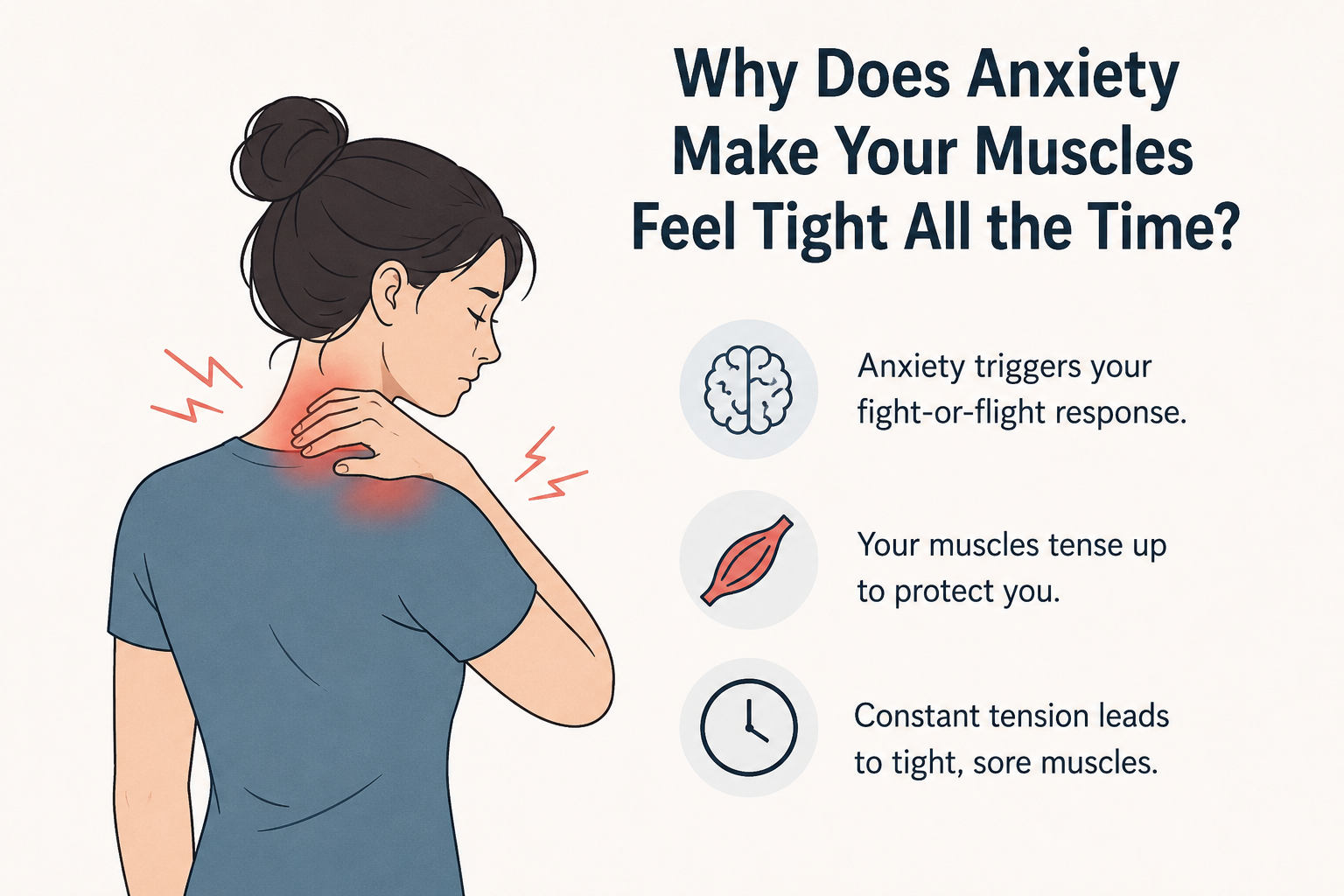
Have you ever noticed that your shoulders feel permanently tense, your jaw stays clenched, or your neck feels stiff even when you haven't exercised?
Anxiety doesn't only affect your thoughts. It can also create very real physical symptoms. Muscle tension, muscle aches, headaches, fatigue, trembling, and sleep problems can occur alongside anxiety.
For some people, the tension can become so familiar that they don't even realize they're doing it.
You might spend hours working at a desk, driving, studying, or worrying about something while unconsciously keeping your muscles contracted.
Over time, this can leave you feeling stiff, sore, exhausted, and physically uncomfortable.
How Does Anxiety Cause Muscle Tension?
The connection starts with your body's natural fight-or-flight response.
When your brain perceives danger or stress, your body prepares to respond. Muscles can tighten as part of this response.
This is useful when you actually need to react to danger.
The problem is that anxiety can activate this response even when there isn't an immediate physical threat. NIMH explains that anxiety is the body's reaction to stress and can occur even when there is no current threat.
Anxiety can create a cycle like this:
Worry → stress response → muscle tightening → discomfort → increased worry → more tension
If this happens repeatedly, your muscles may rarely get a chance to completely relax.
Why Does My Body Feel Tense All the Time?
Persistent anxiety can make relaxation difficult.
You may unconsciously:
Raise your shoulders
Clench your jaw
Tighten your stomach
Grip objects tightly
Hold your neck rigid
Sit with your muscles contracted
Change your breathing pattern
Keep your body in a "ready" position
Eventually, this tension can start to feel normal.
You may not notice it until you consciously relax and realize how tight your muscles have been.
NIMH lists muscle tension and muscle aches among physical symptoms associated with generalized anxiety disorder.
Where Does Anxiety-Related Muscle Tension Usually Occur?
Anxiety can contribute to tension throughout the body, but certain areas tend to be particularly noticeable.
1. Neck and Shoulders
This is one of the most common areas where people notice stress-related tension.
You might experience:
Stiffness when moving your neck
Tight shoulders
Upper-back discomfort
Tension headaches
A heavy feeling around your shoulders
Difficulty relaxing your upper body
Helpful pointer:
Check your shoulders several times throughout the day.
Ask yourself:
"Are my shoulders actually relaxed, or am I holding them up toward my ears?"
You may discover that you're maintaining tension without realizing it.
2. Jaw and Face
Stress and anxiety can cause some people to unconsciously clench their jaw.
Possible signs include:
Jaw soreness
Facial tension
Headaches
Tooth sensitivity
Pain when chewing
Waking with a sore jaw
Helpful pointer:
Try placing your tongue comfortably in your mouth and allowing your teeth to separate slightly when you're not eating.
If you frequently grind or clench your teeth, particularly during sleep, consider discussing it with a dentist.
3. Back
Anxiety-related tension can also contribute to discomfort in the upper or lower back.
This may become more noticeable when anxiety occurs alongside:
Long periods of sitting
Poor posture
Limited movement
Fatigue
Poor sleep
However, not every type of back pain is caused by anxiety. Persistent or severe back pain deserves appropriate medical evaluation.
4. Legs and Other Muscles
Some people notice generalized muscle tension rather than discomfort in just one area.
You may feel:
Heavy legs
Muscle tightness
General body aches
Restlessness
Muscle twitching
Difficulty relaxing
NIMH notes that anxiety symptoms can include muscle aches, tension, trembling, and twitching.
Can Anxiety Cause Actual Muscle Pain?
Yes, anxiety can be associated with genuine physical discomfort.
The pain isn't necessarily imaginary.
Muscle tension itself can be uncomfortable, while stress may also affect sleep, activity levels, posture, and how closely you monitor physical sensations.
NIMH identifies headaches, muscle aches, and tension among possible physical symptoms associated with generalized anxiety disorder.
Remember:
Physical symptoms are real even when anxiety contributes to them.
At the same time, unexplained pain shouldn't automatically be blamed on anxiety because muscle and joint pain can have many possible causes.
Why Can Anxiety Make Existing Pain Feel Worse?
Anxiety and pain can sometimes reinforce one another.
For example:
Muscle pain → worry about the pain → increased anxiety → more muscle tension → increased discomfort
You may begin paying constant attention to your body.
Every small sensation can then feel significant.
You might start thinking:
"Why does my neck hurt?"
"Why are my muscles twitching?"
"Is something seriously wrong?"
"What if this pain gets worse?"
Those thoughts can increase anxiety, which may increase physical tension.
This can become a frustrating cycle.
7 Signs Your Muscle Tension May Be Related to Anxiety
Look for patterns rather than assuming anxiety is automatically responsible.
Your muscle tension may be associated with anxiety if:
It becomes worse during stressful situations.
You notice yourself clenching your jaw.
Your shoulders stay tense during work or concentration.
The discomfort increases when you're worried.
You experience other anxiety symptoms at the same time.
The tension improves when you're relaxed or distracted.
Symptoms become worse during particularly stressful periods.
NIMH notes that anxiety symptoms can fluctuate and may become worse during periods of stress.
Why Does Muscle Tension Get Worse During Stress?
Think about what happens before an important event.
Maybe you have an interview, presentation, doctor's appointment, difficult conversation, or deadline.
Without realizing it, you might:
Tighten your shoulders
Clench your jaw
Sit rigidly
Grip your phone
Hold your breath briefly
Tighten your abdominal muscles
You aren't necessarily choosing to do these things.
Your body's stress response can happen automatically.
If stressful situations happen repeatedly, your muscles may spend much of the day partially contracted.
How Can You Reduce Anxiety-Related Muscle Tension?
Fortunately, there are several strategies that may help.
1. Become Aware of the Tension
Awareness is a surprisingly important first step.
Set a reminder a few times throughout the day.
Then check:
Jaw: Is it clenched?
Shoulders: Are they raised?
Hands: Am I gripping something?
Stomach: Am I tightening my abdominal muscles?
Neck: Am I holding it rigid?
Simply noticing these patterns can help you start releasing unnecessary tension.
2. Try Progressive Muscle Relaxation
Progressive muscle relaxation involves deliberately tightening and then relaxing different muscle groups.
The basic concept is:
Tense → notice the sensation → release → relax
The purpose isn't to make your muscles extremely tight.
Instead, use gentle tension and then focus on the contrast when you release it.
Relaxation techniques are among the strategies NIMH discusses for coping with stress and anxiety.
3. Take Movement Breaks
If you spend several hours sitting, give your body opportunities to move.
Try:
Getting up every so often
Walking around
Gentle stretching
Shoulder movements
Changing your sitting position
Taking a short walk outdoors
Simple rule:
Don't wait until your muscles hurt before you move.
Regular movement can be easier on your body than staying in one position for hours.
4. Pay Attention to Your Breathing
When you're anxious, you may become very focused on your thoughts and less aware of your breathing.
Try slowing down and breathing comfortably rather than taking repeated exaggerated breaths.
If a breathing exercise makes you dizzy or uncomfortable, stop and seek professional advice if symptoms continue.
5. Improve Your Sleep Routine
Poor sleep and anxiety can reinforce each other.
You may sleep poorly because you're worrying, then wake up tired and become more vulnerable to stress the following day.
Try to:
Maintain a consistent sleep schedule
Create a relaxing bedtime routine
Reduce stimulating activities before bed
Avoid excessive caffeine
Give yourself time to wind down
NIMH recommends maintaining a sleep routine and getting enough sleep as part of coping with stress and anxiety.
6. Identify Your Stress Triggers
Ask yourself:
"When does my muscle tension become worse?"
Potential triggers could include:
Finding patterns can help you understand what's contributing to the tension.
7. Consider Professional Help
If anxiety is becoming difficult to control or is interfering with your work, relationships, sleep, or everyday activities, consider speaking with a healthcare or mental-health professional.
NIMH recommends seeking professional help when anxiety begins interfering with everyday life.
Treatment may include psychotherapy, medication, or a combination depending on the individual's situation.
For additional evidence-based information, readers can explore NIMH's Anxiety Disorders resources.
8. Don't Ignore Your Physical Health
It's important not to assume that every muscle ache is caused by anxiety.
Muscle pain can have many possible causes.
Consider getting medical advice if your symptoms are:
Severe
Persistent
Getting progressively worse
Associated with significant weakness
Associated with numbness
Following an injury
Accompanied by swelling or fever
Interfering with normal activities
A healthcare professional can help determine whether anxiety, another physical condition, or several factors may be contributing.
Anxiety and Muscle Tension: The Hidden Connection
One of the biggest problems with anxiety-related muscle tension is that you may not notice it happening.
You can spend hours in a state of physical tension without consciously realizing it.
Then you wonder:
"Why does my body hurt when I haven't done anything strenuous?"
Sometimes the answer is that your body has been working harder than you realized.
Your mind has been worrying.
Your nervous system has been responding.
And your muscles have been staying prepared.
NIMH explains that anxiety can involve persistent worry as well as physical symptoms such as tension and muscle aches.
When Should You Talk to a Doctor?
Don't automatically assume persistent muscle pain is anxiety.
A medical evaluation is especially important when symptoms are unusual, severe, persistent, or accompanied by other concerning physical symptoms.
It's also worth discussing anxiety with a professional when:
Worry feels difficult to control
Anxiety is present most days
You're avoiding normal activities
Sleep is regularly affected
Work or relationships are suffering
Physical symptoms are becoming difficult to manage
Anxiety disorders are treatable, and getting help doesn't mean you have failed to manage your stress.
Final Thoughts
Anxiety can affect much more than your thoughts.
It can influence how your body feels and behaves, including contributing to muscle tension, aches, headaches, restlessness, and sleep difficulties.
The first step is learning to recognize the connection.
When you notice your shoulders tightening or your jaw clenching, pause.
Take a moment.
Relax the muscles you don't need to contract.
Move your body.
Check your breathing.
And consider what might be causing the stress in the first place.
Remember these key points:
Anxiety can cause physical symptoms, including muscle tension.
You may tense your muscles without realizing it.
Stress can make existing discomfort feel more noticeable.
Relaxation, movement, sleep, and stress-management strategies may help.
Persistent or severe pain shouldn't automatically be attributed to anxiety.
Professional support is appropriate when anxiety begins interfering with daily life.
Most importantly, you don't have to simply accept feeling tense all the time. Understanding the anxiety–tension connection can be an important first step toward taking better care of both your mental and physical well-being.