Stress is a normal response to pressure. A demanding workday, financial concern, relationship problem, family responsibility, or major life change can temporarily increase stress and alertness. In many situations, that response helps a person react to challenges and complete important tasks.
The problem can begin when stress does not have enough opportunity to settle.
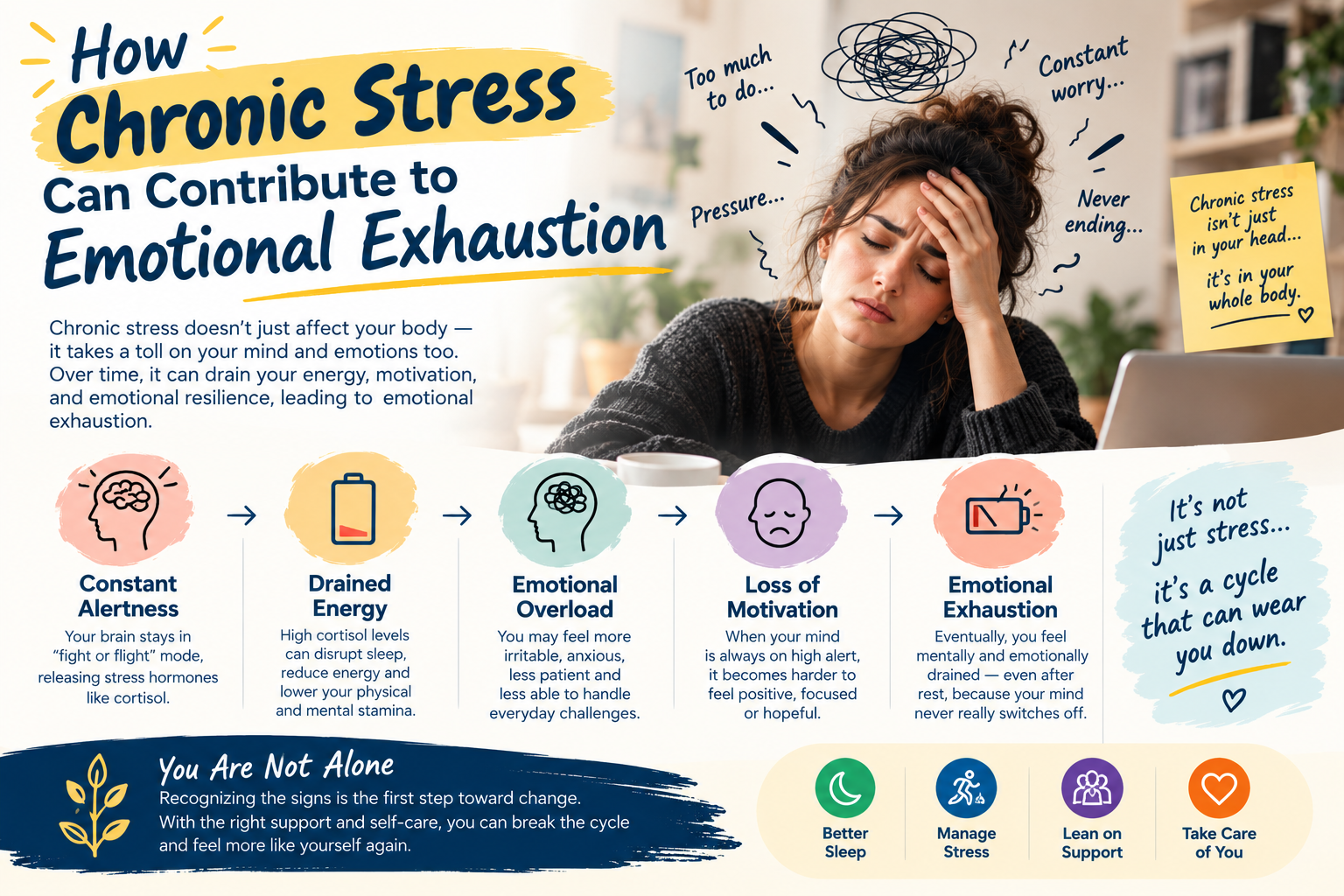
When stressful demands continue for weeks or months, the body and mind may remain in a prolonged state of activation. Over time, this can contribute to sleep difficulties, physical tension, irritability, reduced concentration, low energy, and a growing sense of being emotionally drained.
This is one reason chronic stress can contribute to emotional exhaustion.
According to MedlinePlus, chronic stress is stress that continues for a longer period, such as weeks or months, and prolonged stress can affect both physical and emotional health.
Emotional exhaustion does not necessarily mean that a person has a specific mental-health disorder. It can be a sign that ongoing demands are taking more emotional and physical energy than the person is able to restore.
What Is Chronic Stress?
Chronic stress refers to stress that continues over an extended period rather than resolving after a short-term challenge.
Short-term stress might happen before an examination, presentation, interview, important appointment, or difficult conversation. Once the situation is over, the body's stress response can gradually settle.
Chronic stress is different because the source of pressure continues or repeatedly returns.
Common contributors can include:
Ongoing work pressure
Financial difficulties
Relationship conflict
Caregiving responsibilities
Academic demands
Long-term health concerns
Major life changes
Lack of adequate rest
Persistent uncertainty
Repeated exposure to stressful environments
The MedlinePlus information on stress and health explains that chronic stress can keep the body in a state of alertness and may contribute to symptoms such as tiredness, headaches, muscle tension, sleep problems, and difficulty focusing.
What Is Emotional Exhaustion?
Emotional exhaustion describes a state of feeling emotionally depleted, overwhelmed, or unable to keep responding to ongoing demands with the same energy.
Someone experiencing emotional exhaustion may think:
“I don't have anything left to give.”
It may become harder to feel enthusiastic about activities that previously seemed manageable. Small responsibilities may suddenly feel much heavier.
Possible experiences include:
Feeling mentally drained
Becoming easily irritated
Feeling overwhelmed by ordinary responsibilities
Difficulty concentrating
Reduced motivation
Feeling detached or emotionally numb
Becoming less patient with others
Feeling unable to relax
Sleeping poorly
Feeling tired even after resting
Losing interest in activities
Feeling that everyday responsibilities require excessive effort
Emotional exhaustion can occur for many reasons, so it should not automatically be attributed to stress. Persistent fatigue can also have medical, psychological, sleep-related, or lifestyle causes.
MedlinePlus notes that fatigue can result from emotional stress, lack of sleep, and numerous medical conditions. If tiredness continues for weeks, discussing it with a healthcare professional can help identify the underlying cause.
How Chronic Stress Can Contribute to Emotional Exhaustion
1. The body remains in a prolonged state of alertness
When the brain perceives a challenge or threat, the body activates stress-related responses.
These responses can increase alertness, heart rate, and muscle tension. That can be useful in short bursts.
But when stress becomes persistent, the body may have fewer opportunities to return to a relaxed state.
The American Psychological Association describes chronic stress as stress that persists over an extended period and can affect both psychological and physical well-being.
When this happens repeatedly, maintaining a state of readiness can become exhausting.
2. Stress can interfere with sleep
Sleep is one of the major ways the body and brain recover from daily demands.
Chronic stress can make it harder to fall asleep, stay asleep, or feel rested.
A person may go to bed physically tired but mentally active:
This creates a difficult cycle:
Chronic stress → poor sleep → fatigue → reduced coping capacity → greater stress
MedlinePlus identifies sleep problems as one of the potential effects of long-term stress.
If anxiety is also present, the relationship between stress and sleep can become even more complicated. Our article Why Uncertainty Feels So Uncomfortable When You Have Anxiety discusses how persistent worry can keep the mind focused on possible future problems.
3. Constant problem-solving consumes mental energy
Chronic stress often requires continuous mental attention.
Even when a person is not physically doing anything, their mind may be working constantly:
“How am I going to manage this?”
“What happens if things get worse?”
“Did I make the right decision?”
“What should I do next?”
This ongoing mental effort can make it difficult to experience genuine downtime.
A person may technically be resting while mentally remaining focused on problems.
Over time, that can contribute to feeling emotionally depleted.
Chronic Stress and Muscle Tension
Stress is not purely psychological.
The body's response to stress can involve muscle tension, headaches, digestive symptoms, changes in sleep, and other physical effects. The NHS lists muscle tension or pain, headaches, difficulty concentrating, feeling overwhelmed, and sleep changes among possible stress-related symptoms.
This can create another feedback loop:
Stress → muscle tension → discomfort → reduced relaxation → more stress
Our article Why Does Anxiety Make Your Muscles Feel Tight All the Time? explores the relationship between anxiety and persistent muscle tightness.
Similarly, Why Anxiety Can Cause Muscle Tension and Body Pain explains how emotional stress can be accompanied by physical discomfort.
If muscle tension contributes to headaches, our guide Why Muscle Tension Can Trigger Headaches provides additional information about the connection.
Chronic Stress Can Affect Emotional Regulation
When a person has been under pressure for a long time, emotional responses may become more difficult to manage.
Someone who normally handles minor problems calmly may become:
This does not necessarily mean the person has “changed personality.”
It may reflect the effect of prolonged stress, insufficient recovery, poor sleep, or several factors occurring together.
The NHS notes that stress can contribute to irritability, worry, feeling overwhelmed, difficulty making decisions, and racing thoughts.
Why Emotional Exhaustion Can Make Everyday Tasks Feel Harder
One of the most frustrating aspects of emotional exhaustion is that ordinary responsibilities can begin to feel unusually difficult.
A person may know exactly what needs to be done but still struggle to start.
For example:
“I know I need to answer these emails, but I cannot make myself begin.”
Or:
“I have only a few things to do today, but everything feels overwhelming.”
This can lead to procrastination.
Our article Stress and Procrastination: Why Feeling Overwhelmed Can Delay Everything explores how feeling overwhelmed can interfere with productivity and task completion.
Procrastination may then create additional pressure:
Stress → avoidance → unfinished tasks → more pressure → greater stress
Breaking this cycle often requires reducing the overall load rather than simply demanding more productivity from an already exhausted person.
Chronic Stress, Anxiety, and Depression
Chronic stress does not automatically mean someone has an anxiety disorder or depression.
However, prolonged stress can coexist with or contribute to emotional difficulties.
The National Institute of Mental Health explains that stress and anxiety overlap in some symptoms, while anxiety can continue even when there is no immediate external threat. Persistent symptoms that interfere with daily life may warrant professional evaluation.
Anxiety can involve excessive worry, physical tension, sleep difficulties, and difficulty relaxing.
Depression can involve low mood, reduced interest, low energy, sleep changes, and difficulties functioning.
Our article When Anxiety and Depression Happen Together: Understanding the Overlap discusses how these two conditions can overlap.
Similarly, The Connection Between Depression, Fatigue, and Muscle Pain explores the relationship between low mood, fatigue, and physical discomfort.
Persistent pain and emotional distress can also reinforce one another. See The Pain Depression Cycle: How Muscle Pain and Low Mood Can Reinforce Each Other for more information.
Is Emotional Exhaustion the Same as Burnout?
The terms emotional exhaustion and burnout are sometimes used interchangeably, but they are not necessarily identical.
Emotional exhaustion can occur in many circumstances.
Burnout is more specifically associated with prolonged stress, particularly in occupational contexts.
The World Health Organization's definition of occupational burnout describes it as a syndrome resulting from chronic workplace stress that has not been successfully managed. The NHS also describes burnout as involving physical and emotional exhaustion, reduced motivation, detachment, and difficulty functioning.
The American Psychological Association similarly describes workplace burnout as an occupational syndrome associated with chronic workplace stress and characteristics such as emotional exhaustion and psychological distance from work.
Therefore, someone can experience emotional exhaustion without necessarily meeting a definition of occupational burnout.
Signs That Chronic Stress May Be Taking a Toll
There is no single symptom that proves chronic stress is responsible for emotional exhaustion.
However, a combination of changes may be worth paying attention to.
Emotional signs
Cognitive signs
Physical signs
Headaches
Muscle tension
Body aches
Digestive problems
Sleep difficulties
Persistent tiredness
Changes in appetite
Behavioral changes
Avoiding people
Procrastinating
Working excessively
Losing interest in hobbies
Using unhealthy habits to cope
Withdrawing from normal activities
MedlinePlus and the NHS both emphasize that prolonged stress can produce physical, emotional, cognitive, and behavioral symptoms.
How Can You Reduce the Effects of Chronic Stress?
The goal is not simply to “relax more.”
When stress is chronic, it is often necessary to look at both the source of stress and the way the body and mind are responding to it.
1. Identify the major stressors
Start by identifying what is consistently consuming your mental energy.
Possible sources may include:
Workload
Financial concerns
Family responsibilities
Relationship conflict
Health worries
Lack of sleep
Excessive commitments
MedlinePlus recommends identifying stressors as an important part of learning to manage stress.
You cannot always remove the source of stress, but identifying it can make the situation more concrete.
2. Reduce unnecessary demands
If your schedule contains more responsibilities than you can realistically manage, adding more productivity techniques may not solve the problem.
Instead, ask:
What genuinely needs to be done?
What can wait?
What can someone else help with?
What can be removed entirely?
The APA recommends setting limits and reducing nonessential commitments when chronic stress is contributing to feeling overwhelmed.
3. Protect your sleep
A consistent sleep routine can support recovery from daily stress.
Try to maintain:
Regular sleep and wake times
A relaxing evening routine
A comfortable sleep environment
Reduced stimulating activities close to bedtime
If persistent sleep problems continue despite lifestyle changes, discuss them with a healthcare professional.
4. Include regular physical activity
Physical activity can be part of a broader stress-management strategy.
It does not necessarily need to involve intense exercise.
Walking, stretching, cycling, swimming, or another enjoyable activity may be easier to maintain consistently.
NIMH includes regular exercise among activities that may support mental well-being when dealing with stress and related symptoms.
5. Use relaxation techniques
Relaxation techniques may help reduce the physical effects of stress.
Options can include:
MedlinePlus describes relaxation techniques as one way to help manage the body's stress response.
6. Stay connected to other people
Emotional exhaustion can encourage isolation.
However, maintaining supportive relationships can make stressful periods easier to manage.
You do not necessarily need to explain everything perfectly. Sometimes simply talking with a trusted friend or family member can reduce the feeling that you are carrying every problem alone.
The NHS also recommends talking about feelings with trusted people or a health professional when stress becomes difficult to manage.
When Should You Seek Professional Help?
Stress becomes more concerning when it significantly interferes with daily life or continues without improvement.
Consider speaking with a healthcare professional if you experience:
Persistent exhaustion
Significant sleep problems
Difficulty completing normal responsibilities
Persistent low mood
Loss of interest in activities
Severe anxiety
Difficulty concentrating
Major changes in eating habits
Increasing social withdrawal
Stress that feels impossible to manage
NIMH recommends seeking professional support when symptoms persist, worsen, or interfere with daily functioning.
A healthcare professional can also help determine whether symptoms are related to stress or whether another physical or mental-health condition needs to be considered.
Psychotherapy may be useful for people dealing with severe or long-term stress. NIMH explains that psychotherapy can help people identify and change troubling emotions, thoughts, and behaviors and may be used for long-term stress and related difficulties.
Frequently Asked Questions
Can chronic stress cause emotional exhaustion?
Chronic stress can contribute to emotional exhaustion by maintaining prolonged psychological and physical demands. Persistent stress may also interfere with sleep, concentration, relaxation, and emotional regulation.
What does emotional exhaustion feel like?
It may feel like being mentally and emotionally drained, overwhelmed, irritable, detached, or unable to handle responsibilities that normally feel manageable. Persistent fatigue may also occur, although fatigue has many possible causes.
Can chronic stress cause physical symptoms?
Yes. Prolonged stress can be associated with symptoms such as headaches, muscle tension, digestive problems, sleep difficulties, tiredness, and changes in concentration.
Can stress cause anxiety?
Stress and anxiety are related but are not exactly the same. Stress is generally a response to an external challenge, while anxiety can continue even when there is no immediate external threat.
Is emotional exhaustion the same as burnout?
Not necessarily. Emotional exhaustion can occur in many circumstances, whereas burnout is specifically associated with prolonged stress, particularly chronic workplace stress in the occupational definition.
How long does emotional exhaustion last?
There is no fixed timeline. Recovery depends on the causes, how long the stress has continued, sleep and lifestyle factors, available support, and whether an underlying physical or mental-health condition is present.
When should I talk to a doctor about exhaustion?
If exhaustion lasts for weeks, interferes with daily activities, is worsening, or occurs alongside other concerning symptoms, it is appropriate to speak with a healthcare professional. Persistent fatigue can have many possible causes beyond stress.
Final Thoughts
How chronic stress can contribute to emotional exhaustion is best understood as a process rather than a single event.
When pressure continues for weeks or months, the mind may remain focused on solving problems while the body continues responding to perceived demands. Poor sleep, muscle tension, persistent worry, reduced concentration, and fewer opportunities for recovery can gradually leave a person feeling emotionally depleted.
Recognizing the pattern early can be useful.
Rather than treating exhaustion as a personal failure, consider whether your current demands, sleep, stressors, physical symptoms, and emotional well-being are giving you enough opportunity to recover.
Small changes such as reducing unnecessary commitments, improving sleep habits, maintaining physical activity, practicing relaxation techniques, and staying connected with supportive people may help. When chronic stress is interfering with everyday life, professional support can provide a more individualized assessment and treatment plan.
Stress is common, but feeling overwhelmed by it for a prolonged period is something worth taking seriously.