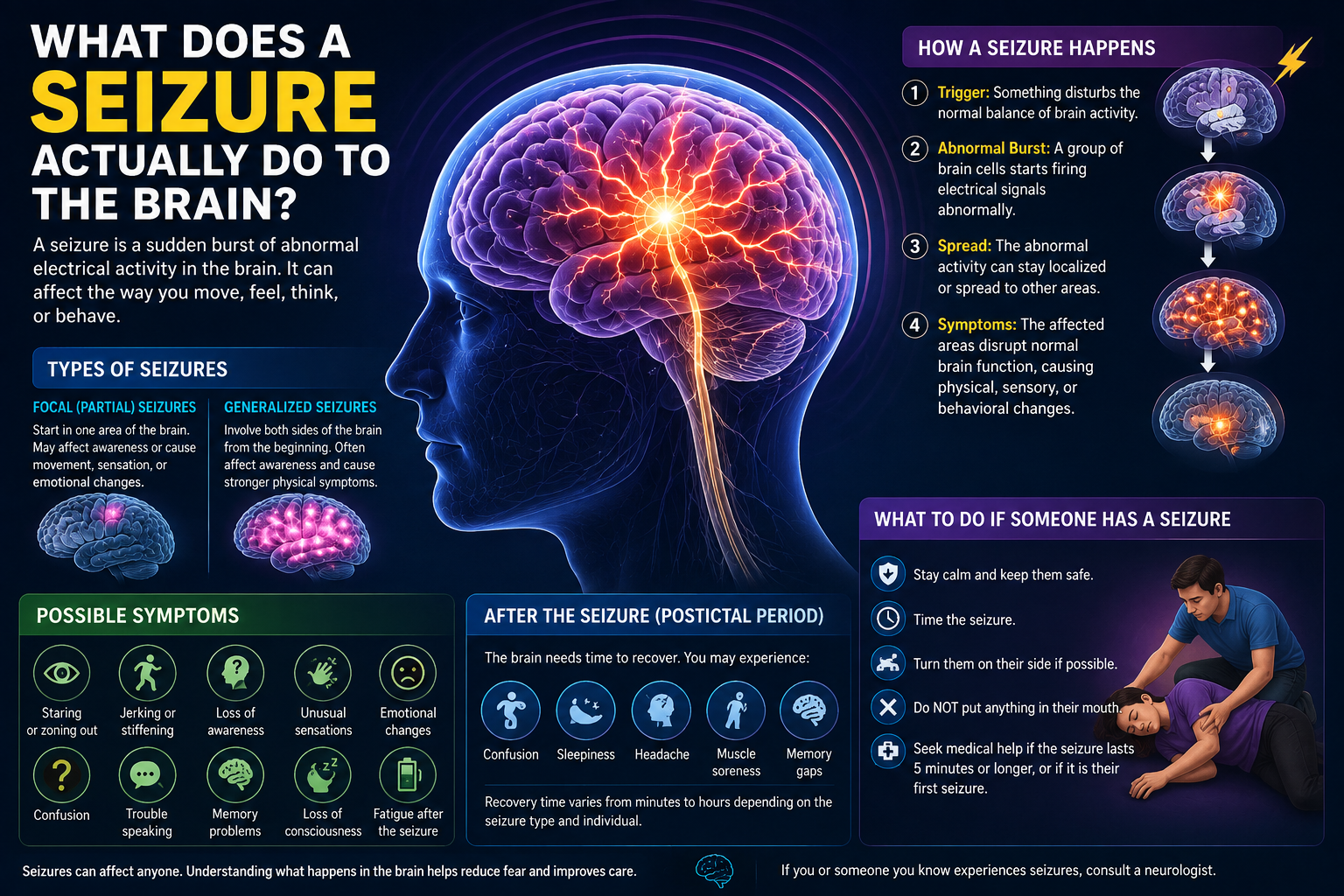
A seizure can look dramatic from the outside—jerking movements, staring, confusion, loss of awareness, unusual sensations, or sudden changes in behavior. But what is actually happening inside the brain?
At its simplest, a seizure is a temporary disruption of normal brain activity caused by abnormal electrical activity involving groups of brain cells. Depending on where the abnormal activity begins and how far it spreads, a seizure can affect movement, memory, speech, emotions, awareness, vision, hearing, or other functions.
Importantly, not every seizure looks like a convulsion, and having a seizure does not automatically mean a person has epilepsy. A seizure can occur for different reasons, while epilepsy is a neurological disorder characterized by a tendency to have recurrent unprovoked seizures. The Epilepsy Foundation explains this distinction clearly in its overview of seizures and epilepsy.
Medical disclaimer: This article is for educational purposes only and is not a diagnosis or substitute for medical care. Anyone experiencing a first seizure, unexplained loss of consciousness, or recurrent unusual episodes should receive appropriate medical evaluation.
What Happens Inside the Brain During a Seizure?
The brain contains billions of neurons that communicate using electrical and chemical signals.
Normally, these signals are carefully regulated. Some neurons encourage other neurons to become active, while other systems help limit or inhibit activity. This balance allows different areas of the brain to communicate in an organized way.
During a seizure, that balance can become disrupted.
The result may be a sudden burst of abnormal electrical activity involving a group of neurons. Depending on the seizure, the activity may remain relatively localized or spread through connected brain networks.
The Epilepsy Foundation describes seizures as sudden bursts of abnormal electrical activity that can temporarily change movement, sensation, behavior, or awareness.
Think of the brain as an enormous communication network. A seizure isn't simply the brain “turning off.” Instead, certain networks may become abnormally synchronized or excessively active, temporarily interfering with the brain's normal processing.
Where a Seizure Starts Matters
One of the most important factors in understanding a seizure is where it begins.
A seizure that starts in one area of the brain can produce symptoms related to the functions controlled or processed by that region.
For example, abnormal activity involving areas responsible for movement may cause twitching or jerking. Activity involving sensory regions may cause tingling or unusual sensations. Involvement of language-related networks can interfere with speech.
Some seizures begin in one hemisphere or a localized network and may remain relatively contained. Others can spread to networks on both sides of the brain.
The National Institute of Neurological Disorders and Stroke (NINDS) describes focal seizures as originating within networks limited to one hemisphere, while generalized seizures rapidly engage networks distributed across both sides of the brain.
This helps explain why seizures can look completely different from one person to another.
Why Can a Seizure Cause Jerking?
One of the most recognizable seizure symptoms is involuntary movement.
If abnormal electrical activity affects motor networks, muscles may contract or relax in ways the person cannot voluntarily control.
This can produce:
But here's an important misconception:
A seizure does not have to involve shaking.
A person can experience altered awareness, unusual sensations, staring, confusion, changes in speech, or other symptoms without dramatic movements.
The Epilepsy Foundation lists a wide range of possible seizure manifestations, including sensory changes, altered awareness, repetitive movements, muscle stiffening, jerking, and changes in speech.
Why Does Someone Sometimes Lose Awareness?
Awareness depends on coordinated activity across multiple brain networks.
If a seizure disrupts networks involved in consciousness and information processing, the person may become confused, unresponsive, or completely unconscious.
Someone experiencing a seizure may:
Stop responding to questions
Stare blankly
Appear confused
Forget what happened
Become unable to speak normally
Lose consciousness
Have difficulty forming memories during the event
The person may appear awake while being unable to respond appropriately.
This is one reason witnesses are often extremely helpful when someone is being evaluated for possible seizures.
What Is a Seizure Aura?
Some people experience a recognizable sensation immediately before or at the beginning of a focal seizure.
This is commonly called an aura.
An aura isn't necessarily a vague feeling of nervousness. It can involve very specific sensory, emotional, cognitive, or physical experiences.
Examples can include:
Déjà vu
An unusual smell or taste
Tingling
Visual changes
A strange rising sensation in the stomach
Sudden fear
Unusual sounds
A feeling of unfamiliarity
Sudden changes in thought
The Epilepsy Foundation explains that an aura can be the first symptom of a seizure and can sometimes occur without progressing to a seizure involving impaired awareness.
This is particularly interesting because some seizure symptoms can resemble experiences associated with anxiety or panic.
For example, sudden fear or a racing sensation doesn't automatically mean that a person is experiencing a panic attack.
That's one reason unexplained recurring episodes deserve proper medical assessment.
Why Can a Seizure Affect Memory?
Memory depends on specialized networks involving several areas of the brain.
If abnormal electrical activity interferes with these networks, a person may experience temporary memory problems.
They might:
The recovery period after a seizure is often called the postictal period.
The duration varies considerably. Some people recover quickly, while others may experience confusion, sleepiness, headache, weakness, or difficulty speaking for minutes or longer.
The Epilepsy Foundation's explanation of seizure stages describes the postictal period as the recovery phase and notes that its duration can depend on the seizure and the brain regions involved.
What Happens After the Seizure Ends?
The brain doesn't necessarily return instantly to its usual state.
After the abnormal electrical activity stops, the person may be:
This recovery period can be confusing for family members.
Someone may appear awake but not behave normally for a period of time.
The important thing is to provide reassurance and keep the person safe while they recover.
Does Every Seizure Damage the Brain?
This is an important question, and the answer isn't simply yes or no.
A brief seizure does not automatically mean that permanent brain damage has occurred.
Seizures vary enormously in cause, duration, severity, and underlying medical context.
However, prolonged seizures can become medical emergencies. A particularly important emergency is status epilepticus, in which seizure activity is prolonged or seizures occur repeatedly without adequate recovery.
This is one reason seizure duration matters.
If a seizure lasts five minutes or longer, emergency medical help should be sought, according to seizure first-aid guidance. Emergency assistance is also appropriate in other situations, such as repeated seizures without recovery, breathing difficulties, serious injury, or when the event is a first known seizure.
Why Do Some People Develop Epilepsy?
A seizure and epilepsy are not synonymous.
A person may experience a seizure because of an acute medical problem, while another person may have epilepsy because their brain has an enduring tendency toward recurrent seizures.
Potential factors associated with seizures or epilepsy can include:
In some people, however, doctors may not identify a clear cause.
The Epilepsy Foundation notes that seizures can have many causes and that sometimes the underlying cause remains unknown.
How Do Doctors Determine What Happened?
Diagnosing a seizure isn't always straightforward.
A neurologist may want to know:
What happened before the event?
Was there a warning sensation, unusual smell, fear, dizziness, or another symptom?
What happened during it?
Did the person stare, become unresponsive, stiffen, jerk, wander, speak unusually, or experience another change?
What happened afterward?
Was there confusion, sleepiness, weakness, headache, or memory loss?
Witness information can therefore be extremely valuable.
Doctors may also use tests such as an electroencephalogram (EEG), which records electrical activity in the brain.
The Epilepsy Foundation explains that EEG testing can help clinicians look for electrical patterns associated with seizures.
Depending on the circumstances, healthcare professionals may also consider brain imaging, blood tests, medical history, medication history, and other investigations.
Why Seizures Can Be Confused With Other Conditions
Not every unusual episode is a seizure.
Some symptoms can overlap with:
This is particularly relevant when someone experiences sudden fear, shaking, dizziness, altered awareness, or unusual sensations.
A person shouldn't assume that an episode is “just anxiety” or “definitely epilepsy” based solely on symptoms found online.
Proper diagnosis requires looking at the complete clinical picture.
What Should You Do If Someone Has a Seizure?
The first priority is safety.
Stay with the person and remain calm.
Move nearby dangerous objects away if possible. If the person is falling, protect them from injury without attempting to restrain their movements.
Time the seizure.
Do not put anything in the person's mouth and do not attempt to force their jaw open.
The Epilepsy Foundation's seizure first-aid guidance recommends staying with the person, timing the seizure, keeping them safe, and following appropriate emergency guidance.
Emergency assistance is especially important when the seizure lasts five minutes or longer, another seizure follows immediately, breathing is difficult, the person has been seriously injured, or other concerning circumstances are present.
How Are Seizures Treated?
Treatment depends on the underlying cause and type of seizure.
For people with epilepsy, doctors may prescribe anti-seizure medications to reduce the likelihood of future seizures.
Treatment isn't necessarily identical for everyone.
Some people achieve good seizure control with medication. Others may require additional approaches, particularly when seizures remain difficult to control.
For selected people with drug-resistant epilepsy, specialist teams may consider options such as epilepsy surgery or other advanced treatments.
NICE notes that drug-resistant epilepsy may require assessment by a multidisciplinary specialist team and that surgical approaches can be considered in appropriately selected patients.
The Brain Is More Than an Electrical Machine
It's tempting to describe a seizure as simply an “electrical storm,” but the biology is more complicated.
Neurons communicate through intricate electrical and chemical processes, and seizures involve networks rather than just one isolated malfunctioning cell.
Researchers continue to study how abnormal activity begins, how it spreads through brain circuits, and why some brains become more susceptible to recurrent seizures.
Understanding these mechanisms may eventually lead to more personalized treatments.
The Epilepsy Foundation's discussion of epileptic circuits explains that seizure activity can involve a starting region, networks that sustain the activity, and pathways through which it spreads.
Final Thoughts
So, what does a seizure actually do to the brain?
A seizure temporarily disrupts normal brain activity through abnormal electrical activity involving neurons and connected brain networks.
Where the activity begins and how far it spreads can determine whether the person experiences:
Afterward, the brain may need time to return to its usual state, producing the fatigue and confusion commonly associated with the postictal period.
Most importantly, seizures are not all the same. A dramatic convulsion is only one possible presentation.
If someone experiences a first seizure, recurrent unexplained episodes, sudden loss of awareness, or unusual neurological symptoms, professional evaluation is important. A proper diagnosis can distinguish seizures from other conditions and help determine whether treatment is necessary.